
André Lhote sanatçısının Le Judgment de Paris eseri hakkında uzman analizi
Tarz: Cubism · Tür: genre painting
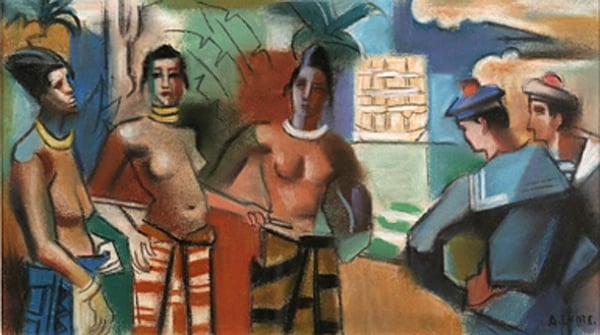
André Lhote’s Le Judgment de Paris stands as a compelling example of how Cubism could be adapted to narrative, mythological themes—an approach that distinguishes Lhote from more abstract or non-objective Cubists. Working within the genre painting tradition (here treating a classical myth as a contemporary scene), Lhote synthesizes the fractured planes and multiple viewpoints of Cubism with a legible, story-driven composition.
What makes this work significant:
-
Cubism as narrative vehicle: Unlike early Cubist works by Picasso and Braque that often focused on still lifes or portraits, Lhote applies Cubist geometry to a mythological judgment scene. The diagonal facets and overlapping forms do not dissolve the figures into pure abstraction; instead, they animate the encounter between Paris, Venus, Juno, and Minerva, creating a sense of dynamic, fragmented space that mirrors the psychological tension of the choice.
-
Classicism filtered through modernism: Lhote was a key figure in the “Cubist classicism” trend of the 1920s, seeking to reconcile avant-garde structure with traditional subject matter. In Le Judgment de Paris, the muscular, simplified bodies and architectural setting recall Poussin or Ingres, but those bodies are built from prismatic blocks and shallow, interlocking planes. This dual allegiance makes the work a bridge between the revolutionary language of Cubism and the enduring appeal of Greco-Roman narrative.
-
Accessible Cubism for a broader audience: Lhote’s painting is often cited as “Cubism for the salon” — rigorous in its faceting and color modulation (earthy ochres, blues, and greens) yet still readable as three figures in a landscape. This accessibility helped popularize Cubist principles among collectors and the public without sacrificing the movement’s core innovations.
-
Genre painting elevated: By treating the Judgment of Paris not as a grand historical allegory but as a genre scene — a moment of human (and divine) interaction rendered with everyday solidity — Lhote democratizes the myth. The gods appear not as ethereal beings but as tangible, volumetric presences, grounded in the same cubist geometry as any still life.
In summary, Le Judgment de Paris is significant as a masterful fusion of Cubist technique with classicist narrative, demonstrating that avant-garde form could serve traditional storytelling without losing its radical edge.
Stil
Görsel olarak benzer
İlişkili kompozisyon ve renk paletine sahip 20 eser
Three Women in Malta
Marcel Janco
Untitled (Seven Figures)
Charles Alston
Couple
Alexander Bogen
South Indian Villagers Going to a Market
Amrita Sher-Gil
Portrait (Dulcinea)
Marcel Duchamp
Nude with Red Turban
Bela Czobel
On the Beach
Roman Selsky
Bathers
Rudolf Bér
Truman Capote in Hollywod
Eric Fischl
Two Women at the Sea
Ernst Ludwig Kirchner
Inca with Birds
Wyndham Lewis
3 Women queens of desire
Genis Remacha
Conversation
Volodymyr Loboda
Woman with Pineapple
Rufino Tamayo
Delectable Waters
Paul Gauguin
Two Bathers
Ernst Ludwig Kirchner
As Erradias
Lasar Segall
Bathers at Sea
Ernst Ludwig Kirchner
Slash and Burn
Leon Underwood

Beach Scene
Grégoire Michonze