Expert analysis of Paul Feeley’s Alruccabah
Style: Color Field Painting · Genre: abstract
Expert Analysis: "Alruccabah" by Paul Feeley
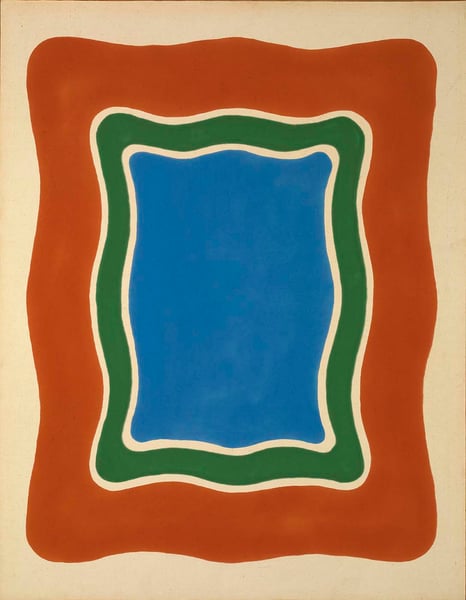
Paul Feeley’s "Alruccabah" stands as a compelling exemplar of mid-century Color Field painting, a movement that prioritized the physical and optical properties of pure color over narrative or gestural expression. Although the artwork is abstract—relying entirely on form, hue, and composition—its significance lies in how Feeley refined the vocabulary of post-painterly abstraction.
Formal Characteristics
True to Feeley’s mature style, "Alruccabah" likely features a limited palette of saturated, synthetic colors (often primaries or secondaries) applied in flat, unmodulated passages. The composition is built from repeated, simple geometric motifs—most notably the column or baluster shape that became Feeley’s signature. These forms are arranged in a rhythmic, grid-like pattern, creating a sense of vertical procession across the canvas. The figures are symmetrical, hard-edged, and precisely separated by areas of bare or lightly tinted canvas, which allows each color block to breathe independently.
Significance within Color Field Painting
Feeley’s work is crucial in distinguishing two strands of Color Field painting: the lyrical, stained-canvas approach of Helen Frankenthaler or Morris Louis, and the more structured, constructionist approach that Feeley championed. Where other Color Field painters dissolved the figure–ground relationship through soak-staining, Feeley maintained a firm geometric armature. His forms are not organic blots but designed emblems—a bridge between the all-over color fields of Barnett Newman and the hard-edge abstraction of Ellsworth Kelly.
"Alruccabah" exemplifies this tension: the repeated, almost architectural pillars activate the entire picture plane while still allowing color to function as the primary subject. The title itself—a name for the North Star (from Arabic al-rukkabah, “the Rider”)—suggests a celestial or navigational anchor, aligning with Feeley’s interest in using color to create a stable, meditative focal point.
Influence and Legacy
Feeley was also a vital teacher at Bennington College, where he influenced artists like Kenneth Noland and Anthony Caro. In "Alruccabah", we see the principles he imparted: color as structure, the elimination of compositional hierarchy, and the search for a focused, non-illusionistic space. This artwork is significant because it proposes that color itself can build architecture—a serene, frontal presence that neither recedes nor advances, but simply is.
In summary, "Alruccabah" is a key work in understanding how Color Field painting evolved toward a rigorous, decorative geometry, and it remains a testament to Feeley’s singular contribution to American abstraction in the 1960s.
Visually similar
20 works with related composition and palette
Blockade
Jo Baer
Blue Moon
Kenneth Noland
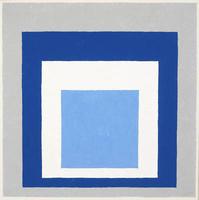
Homage to the Square: Blue, White, Grey
Josef Albers
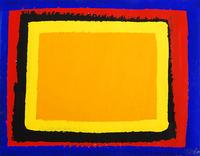
Untitled
Al Held
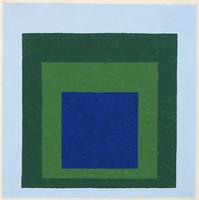
Homage to the Square: Blue & Green
Josef Albers
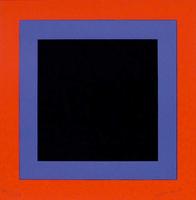
Tournoi
Aurelie Nemours
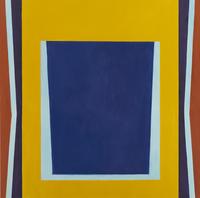
Blockade
Jo Baer
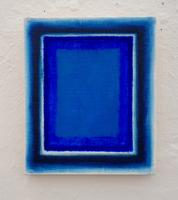
1410238 2
Kosakov Dimitrij
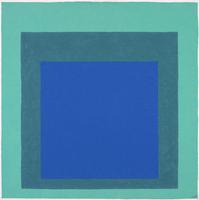
Homage to the Square
Josef Albers
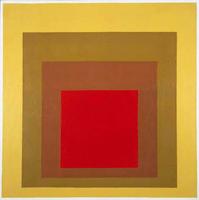
Homage to the Square
Josef Albers
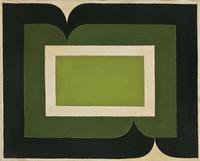
Série Amazônica n° 12
Ivan Serpa
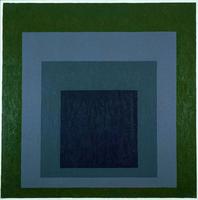
Homage to the Square
Josef Albers
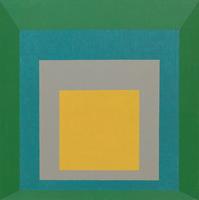
Homage to the Square. Apparition
Josef Albers
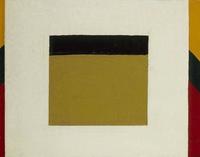
White Square
Al Held
Couleur non lumière
Horacio Garcia-Rossi
Homage to the Square (La Tehuana)
Josef Albers
Study for Homage to the Square (Terrassed Foliage)
Josef Albers
Homage to the Square
Josef Albers
Homage to the Square (Greek Island)
Josef Albers
Homage to the Square
Josef Albers