Expert analysis of Paul Feeley’s Arpa
Style: Color Field Painting · Genre: abstract
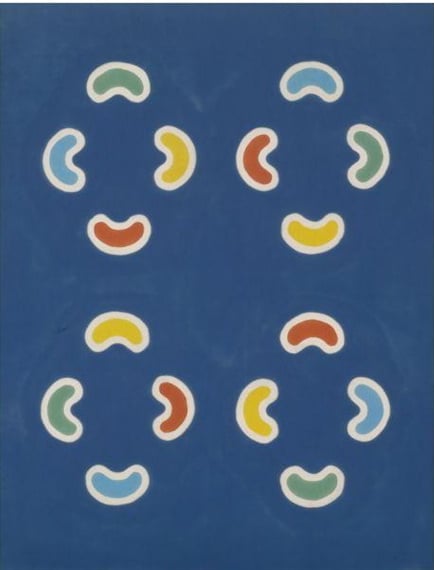
The painting Arpa by Paul Feeley is a compelling example of mid-20th-century Color Field abstraction, a movement that shifted focus away from gestural mark-making toward the primacy of pure, unmodulated color and simplified form.
Significance within Color Field Painting:
Feeley’s work stands out for its rigorous hard-edge geometry and rhythmic, almost architectural compositions—traits that distinguish him from the more painterly stain techniques of contemporaries like Helen Frankenthaler or Morris Louis. In Arpa, Feeley likely employs his signature vocabulary of repeated, column-like arcs or “beam” shapes, arranged in a measured, symmetrical format. The title (Italian for “harp”) suggests a visual metaphor for taut, musical lines and intervals, which aligns with Color Field’s interest in creating optical vibration and spatial tension through hue and placement.
Formal qualities and innovation:
Feeley’s palette in Arpa probably consists of bold, saturated primaries or secondaries (e.g., red, yellow, blue) set against a flat, often white or muted ground. By eliminating brushwork, texture, and representational cues, he pushes the viewer toward a purely perceptual experience—color as subject. The repeating forms create a syncopated rhythm that echoes the movement in a harp’s strings, while the strict frontality and symmetry evoke a sense of iconic, totemic presence. This reduction to elemental shape and color places Feeley alongside other Post-Painterly Abstractionists who sought to strip painting down to its optical essence.
Historical context and legacy:
As a teacher at Bennington College (where he influenced artists like Kenneth Noland and Jules Olitski), Feeley helped shape the second generation of Color Field painters. Arpa exemplifies his belief that “color is the first and last thing” in painting—a testament to the movement’s radical redefinition of pictorial space, where color alone generates depth, movement, and meaning. The work’s deliberate restraint and clarity also prefigure later Minimalist and Hard-edge tendencies, cementing Feeley’s role as a bridge between Abstract Expressionism’s emotional intensity and the cooler, systematic approaches of the 1960s.
Visually similar
20 works with related composition and palette
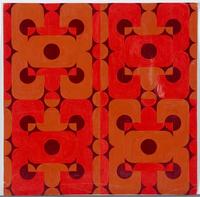
Untitled
Soledad Sevilla
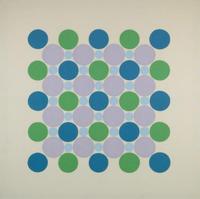
Four Blue Five
Thomas Downing
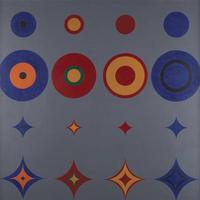
Untitled, #1
Larry Poons
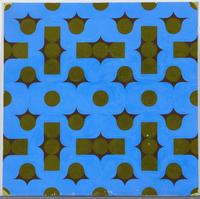
Untitled
Soledad Sevilla
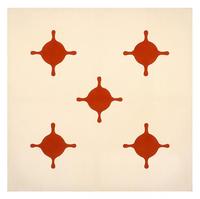
Untitled (February 26)
Paul Feeley
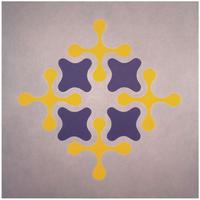
Crucifixion
Philip Taaffe
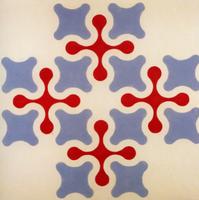
Gomelza
Paul Feeley

S-60-69
Nassos Daphnis
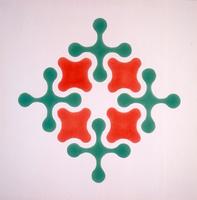
Etamin
Paul Feeley
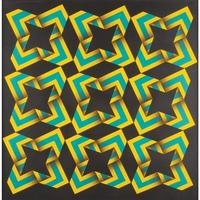
9-Soles
Omar Rayo
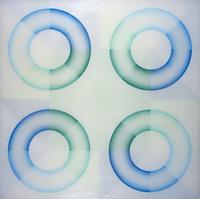
Pasadena Lifesavers Blue Series #2
Judy Chicago
Alya
Paul Feeley
Untitled
Soledad Sevilla
Rivet Lilt
Thomas Downing
The Fourth 'Book of Schemes'. Album #1, the Second Folder
Valerii Lamakh
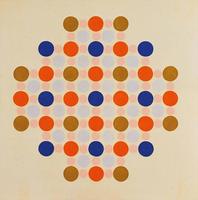
Dream Rate
Thomas Downing
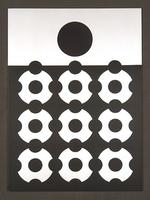
Relief Metal
Victor Vasarely
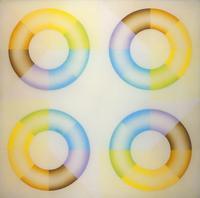
Pasadena Lifesavers Yellow Series #2
Judy Chicago
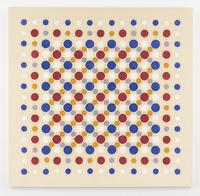
Reel
Thomas Downing
Stroboscopic Drawing with Circles
Ludwig Wilding