Amadeo de Souza-Cardoso の Azenhas の専門的な分析
スタイル:Cubism · ジャンル:cityscape
Expert Analysis: "Azenhas" by Amadeo de Souza-Cardoso
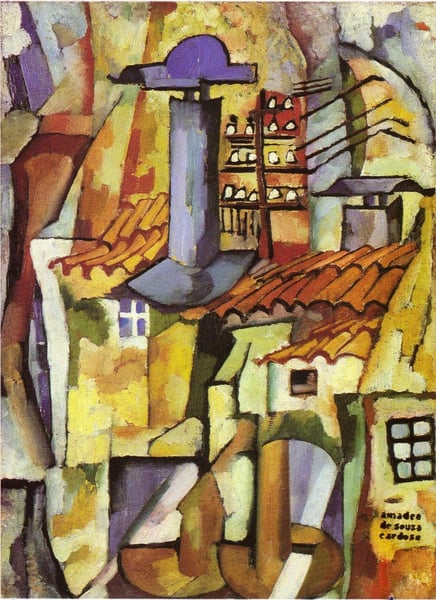
Amadeo de Souza-Cardoso’s “Azenhas” (c. 1915–1917) stands as a remarkable synthesis of European Cubist principles and a distinctly Portuguese sensibility, marking a pivotal moment in the artist’s brief but explosive career. Executed in the Cubist style with the cityscape as its nominal genre, the work transcends mere urban representation to become a vibrant, fractured meditation on rural industrial life—a theme that sets it apart from the Parisian café and boulevard motifs typical of the movement’s mainstream.
Significance Within Cubism and Portuguese Modernism:
-
Hybrid Space: Unlike the purely analytical Cubism of Picasso and Braque, which often dissolved objects into near-abstract facets, “Azenhas” retains a recognizable subject: a cluster of watermills (azenhas in Portuguese) nestled in the Sintra hills. Souza-Cardoso superimposes multiple perspectives (the flume, the wheel, the rooftops) within a compressed, planar structure, yet he never fully abandons the viewer’s ability to read the scene. This balance of abstraction and reference was his hallmark, proving that Cubism could articulate local architectural forms without losing its revolutionary edge.
-
Color as Structure: While early Cubism favored muted earth tones, “Azenhas” bursts with expressive, almost Fauve-like color—ocher, blue, green, and red. Souza-Cardoso uses chromatic planes not merely as decorative elements but as structural building blocks, matching the angular black lines that segment the canvas. This bold palette aligns him with the “Cubisme orphique” of Robert Delaunay (whom he admired) but adds a sun-drenched, Iberian warmth that feels both modern and rooted.
-
Rural as Avant-Garde: Perhaps most significant is Souza-Cardoso’s choice of subject. At a time when urban centers dominated Cubist cityscapes, “Azenhas” turns to a semi-rural watermill—a symbol of pre-industrial labor. By fragmenting this humble structure with the same rigor he would apply to a Parisian café, the artist asserts that modernity is not exclusive to the metropolis. The dynamism of the water wheel and the tumbling lines of the mill become emblems of a new, kinetic rhythm, echoing the speed of technology while honoring traditional craftsmanship.
-
A Bridge Between Centers: Created during Souza-Cardoso’s restless period between Paris and Portugal, “Azenhas” reflects his unique position as an outsider-insider. He absorbed the methods of the Cubist avant-garde (Cézanne’s faceting, Braque’s papier collé) but filtered them through a national consciousness. This synthesis makes the work a critical document of how non-French modernists adapted Cubism to local contexts—an early example of what would later be called “transnational modernism.”
In sum, “Azenhas” is not merely a Cubist cityscape; it is a manifesto. It demonstrates that Cubism’s radical language could speak of Portuguese light, stone, and water as fluently as it spoke of Parisian geometries. Amadeo de Souza-Cardoso, who died tragically young in the 1918 flu pandemic, left in this painting a testament to his fearless originality—a work that still resonates as a landmark of early 20th-century art.
視覚的に類似
構図やパレットが近い作品 20 件
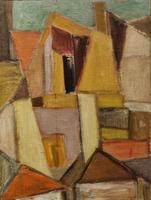
Modok Mária, Szentendrei Tetők 1940
Modok Mária
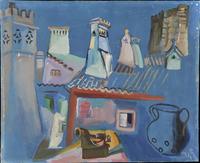
Chaminés alentejanas
Mily Possoz
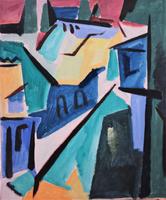
Gurzuf
Volodymyr Loboda
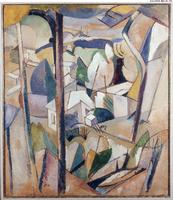
Untitled
Albert Gleizes
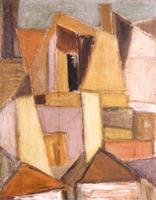
Modok Mária. Szentendrei Háztetők 1940
Modok Mária
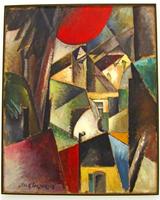
Landscape with Mill
Albert Gleizes
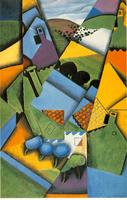
Landscape with House at Ceret
Juan Gris
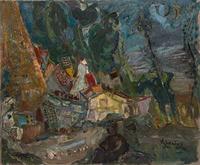
Landscape
Michel Kikoine
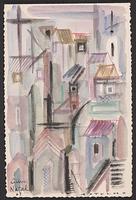
Lisbon (Portugal christmas card to Harold Weston)
Carlos Botelho
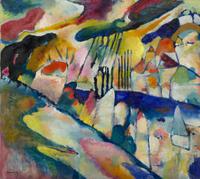
Landscape with Rain
Wassily Kandinsky
The level Crossing
Fernand Leger
Mirmande
André Lhote
Untitled
Pablo Picasso
The Village
Jean Metzinger
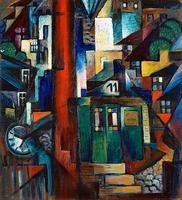
House in Nöden, Lund
Gosta Adrian-Nilsson
Santa Panagia (Sicily)
Renato Guttuso
Vajda Lajos Houses in Szentendre 1937 Tempera on Cardboard, 28x43cm
Vajda Lajos
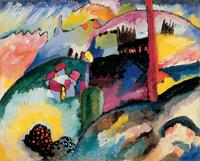
Landscape with factory chimney
Wassily Kandinsky
Zigeunerkind Im Dorf
Otto Mueller
Still-life with cross
Minas Avetisyan