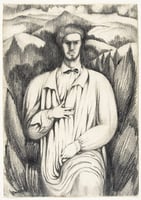
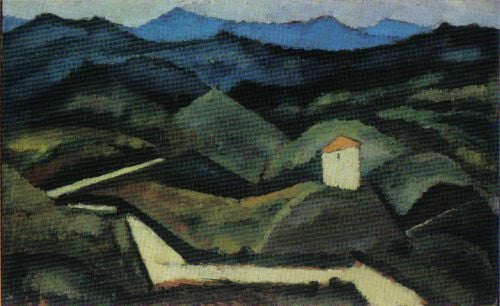
Expertenanalyse zu Amadeo de Souza-Cardosos Windmill
Stil: Cubism, Expressionism · Genre: landscape
Expert Analysis: "Windmill" by Amadeo de Souza-Cardoso
Amadeo de Souza-Cardoso’s Windmill stands as a compelling synthesis of Cubist structure and Expressionist emotional intensity, marking a pivotal moment in early 20th-century modernist landscape painting. The work is significant for how it transposes the rural, pastoral subject—a windmill—into a dynamic, fractured visual language that reflects the artist’s unique position as a Portuguese modernist deeply engaged with the Parisian avant-garde.
While the vertical silhouette of a traditional windmill remains legible, the landscape is broken into shifting, interlocking planes typical of Cubism. This fragmentation does not aim for analytical detachment; instead, it is charged with Expressionist energy. The palette is vivid and often dissonant—deep blues, sharp greens, and fiery oranges—transforming the scene into a subjective, almost turbulent experience of nature. The brushwork is aggressive and visceral, with thick impasto and visible strokes that evoke emotional urgency rather than descriptive fidelity.
What makes Windmill particularly significant is its refusal to be subsumed into either Cubism or Expressionism alone. Souza-Cardoso infuses the geometric rigor of Cubism (derived from Picasso and Braque) with the raw, existential vibration of German Expressionism and Fauvist color. The result is a landscape that feels both constructed and felt, intellectual yet immediate. This hybridity places him as a crucial, though often overlooked, bridge between the major movements of the era.
Moreover, the work challenges the hierarchical divide between urban, avant-garde subjects and rural, traditional ones. By applying the most radical formal innovations of his time to a humble windmill, Souza-Cardoso asserts that modernist vision can transform any locale into a site of radical pictorial experiment. Windmill is therefore not merely a provincial echo of Parisian trends but a bold, singular statement of a cosmopolitan artist who turned the Portuguese landscape into a laboratory for modernist expression.
Visuell ähnlich
20 Werke mit ähnlicher Komposition und Farbpalette
Untitled
Moise Kisling
Study for autumn
Wassily Kandinsky
Landscape at Vence
Christopher Wood
Blauer Berg
Alexej von Jawlensky
Figures on a Winding Path
Michel Kikoine
Mountain landscape with church
Wassily Kandinsky
Near Siena
Pyotr Konchalovsky
Landscape at Ferte Soud Jouarre
Roger de La Fresnaye
Tunk Mountains, Autumn, Maine
John Marin
Egry József, Hegyoldal,.
Egry József
Etruscan Hills, Umbria
William Balthazar Rose
Landscape with a house
Ilya Mashkov
BLAUER KEGELBERG
Gabriele Munter
Neighborhoods Khvalynsk
Kuzma Petrov-Vodkin
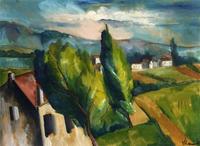
View of a Village with Red Roofs
Maurice de Vlaminck
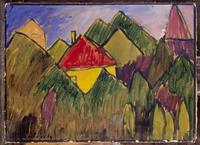
Rote Giebel - Rote Dächer
Alexej von Jawlensky
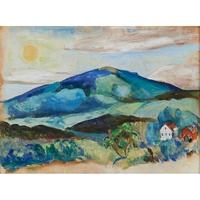
Mountain in New Hampshire
O. Louis Guglielmi
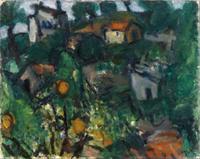
Bela Adalbert Czobel, Cagnes
Bela Czobel
Red Rooftops near Marnat
Émilie Charmy
Summer Memories
Bela Czobel