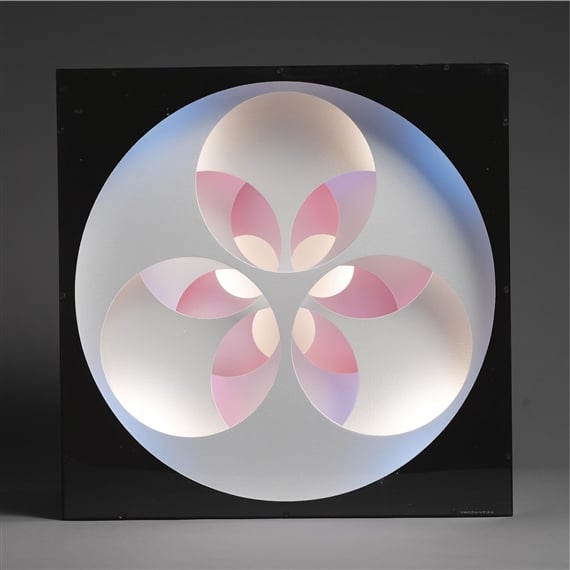
Arabesque Chromatique
Analisi esperta di Arabesque Chromatique di Gregorio Vardanega
Stile: Op Art · Genere: installation
Expert Analysis: "Arabesque Chromatique" by Gregorio Vardanega
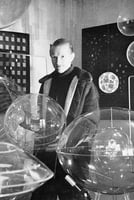
Gregorio Vardanega’s Arabesque Chromatique is a landmark work of Op Art and kinetic installation, embodying the movement’s core ambition: to transform passive viewing into an active, perceptual experience. As a member of the Groupe de Recherche d’Art Visuel (GRAV), Vardanega prioritized systematic, optical effects over subjective expression, and this piece exemplifies that ethos through its precise interplay of light, color, and geometry.
Significance within Op Art:
-
Fusion of Motion and Chromatic Illusion – The title “Arabesque Chromatique” signals a deliberate marriage of fluid, rhythmic form (arabesque) with a spectrum of shifting hues (chromatic). Unlike static Op paintings by contemporaries like Bridget Riley or Victor Vasarely, Vardanega’s installation introduces literal movement—often via rotating elements or motorized components—so that the “arabesque” unfolds in real time. This engages the viewer’s peripheral vision and afterimage effects, creating a sense of color that vibrates and “breathes” without ever physically changing the work’s pigments.
-
Spatial and Temporal Immersion – As an installation, Arabesque Chromatique envelops the audience. Viewers are not merely looking at an image; they are situated within a dynamic environment of projected or reflected light. This aligns with GRAV’s goal to “engage the spectator”—to make them conscious of their own perceptual processes. The piece disrupts the boundaries between art object and lived space, a radical move in the 1960s that anticipated later immersive and interactive art.
-
Scientific Rigor and Poetic Sensibility – Vardanega’s background in engineering and his fascination with cybernetics allowed him to treat color and light as programmable phenomena. Arabesque Chromatique demonstrates a controlled, almost mathematical progression of hues—often based on color wheel sequences—yet the resulting undulating pattern evokes a lyrical, almost musical quality. This tension between systematic order and organic fluidity is a hallmark of Op Art’s greatest achievements.
-
Influence on Later Media Art – By combining colored light, motorized motion, and architectural scale, Vardanega prefigured developments in light art, projection mapping, and even digital generative art. Arabesque Chromatique is a forgotten but crucial precursor to works by artists like James Turrell or Olafur Eliasson, where the immaterial substance of light becomes the primary medium.
Conclusion:
Arabesque Chromatique is significant because it expands Op Art from flat canvas into kinetic, environmental spectacle. It challenges the viewer to question the stability of color and form, revealing perception itself as an active, creative act—an experience that remains as relevant today as it was at its creation.
Visivamente simili
20 opere con composizione e palette affini
Trihex
Leo Villareal
Untitled
Piero Dorazio
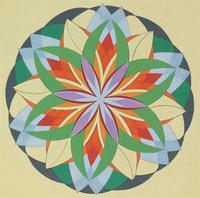
Rosette
Robert Strubin
Untitled
Gerhard von Graevenitz
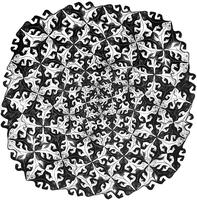
Division
M.C. Escher
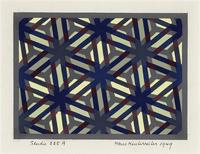
Study 225A
Hans Hinterreiter
The Fourth 'Book of Schemes'. Album #2, the First Folder
Valerii Lamakh
Zone riflesse
Paolo Scheggi
Integration 40 x 39 cmóleo sobre madeiraass
Martha Boto

4 Squeezed Squares I (White)
Jan Maarten Voskuil
Rosette
Robert Strubin
Reloj espacial
Gyula Kosice
Cheyt Pyr
Victor Vasarely
Combinatory system
Florin Maxa
Diamond Space
Loutphi
Orphée
Pierre Kiandjan
4 Cercles Ex-Centriques
Gregorio Vardanega

Circular Void
Ron Cooper
Big Bang
Leo Villareal
Lunatique compact n° 3
Francois Morellet