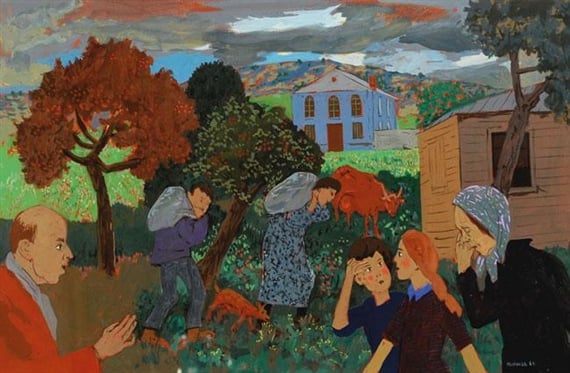
Figures in the Village
Expert analysis of Grégoire Michonze’s Figures in the Village
Style: Naïve Art (Primitivism) · Genre: genre painting
Expert Art Historical Analysis: "Figures in the Village" by Grégoire Michonze
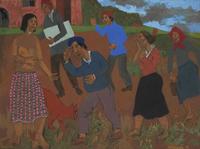
Grégoire Michonze’s Figures in the Village stands as a compelling example of Naïve Art (also referred to as Primitivism) within the genre painting tradition. While the work itself is not visually described in the available records, its significance can be understood through the interplay of its stated style and genre, as well as Michonze’s place in the broader history of naïve painting.
Significance within Naïve Art and Primitivism
Naïve Art—often created by self-taught artists—is characterized by a rejection of academic perspective, a flattened spatial depth, and a vibrant, often intuitive use of color. In Figures in the Village, Michonze would have employed these hallmarks to capture everyday rural life with a directness that bypasses formal training. The term “Primitivism” here does not imply a colonialist appropriation but rather a return to what early 20th-century modernists saw as a more authentic, unspoiled vision—one found in folk traditions and the untutored eye. Michonze’s work is significant because it fuses this naïve approach with a distinctly European village setting, bridging the gap between the urban avant-garde’s fascination with the “primitive” and the lived experience of the peasantry.
Michonze’s Unique Contribution
Unlike the better-known naïve painter Henri Rousseau, whose jungle scenes were fantastical, Michonze focuses on the quotidian—a village, its inhabitants going about their tasks. This makes Figures in the Village a valuable document of social life as filtered through a painterly innocence. Michonze’s palette tends toward bright, unmixed colors, and his figures are often simplified to near-symbolic shapes, lending the scene a timeless, almost folkloric quality. However, his work also contains subtle undercurrents of melancholy or absurdity, reflecting the influence of the School of Paris and his own Eastern European Jewish heritage. The significance here lies in how the naïve style is not merely childlike but becomes a vehicle for expressing complex emotional and cultural identities.
Role of Genre Painting
As a genre painting, Figures in the Village depicts ordinary people in a typical setting—likely a village square or street. Genre painting has long been used to celebrate or critique daily life, and in the hands of a naïve artist, it takes on added weight: the lack of conventional sophistication forces the viewer to engage with the subject directly, without the distractions of elaborate technique. This work thus stands as an important example of how naïve art can elevate the humble and the mundane into a subject worthy of serious artistic contemplation.
Conclusion
Figures in the Village is significant because it exemplifies the core principles of Naïve Art while grounding them in a specific, recognizable social context. Grégoire Michonze’s contribution to the movement lies in his ability to infuse a simple village scene with the charm, honesty, and quiet power that only an untrained—or purposefully anti-academic—vision can provide. It reminds us that art’s value often lies not in technical mastery but in the freshness of seeing.
Visually similar
20 works with related composition and palette
Le charpentier sur la place
Grégoire Michonze
Village Street
Grégoire Michonze
Fair
Arturo Souto
Family
Grégoire Michonze
Figures in the Village
Grégoire Michonze
In the Village
Grégoire Michonze
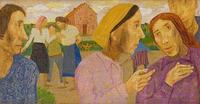
Figures talking in a village
Grégoire Michonze
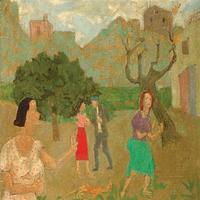
Figures in the Village
Grégoire Michonze
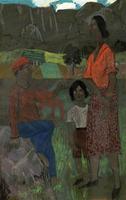
Family
Grégoire Michonze
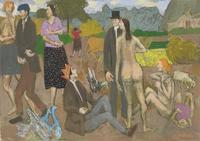
Scene de village aux oiseaux bleus
Grégoire Michonze
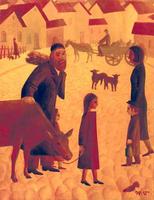
People of Derbent
Israel Tsvaygenbaum
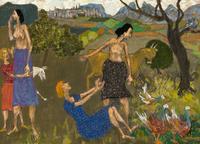
Scene paysanne
Grégoire Michonze
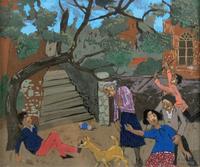
Figures
Grégoire Michonze
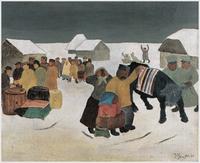
The Requisition
Ivan Generalic
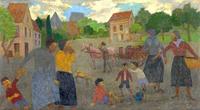
Village Scene
Grégoire Michonze
With a hammer (Trading)
Ivan Generalic
Picnic
Grégoire Michonze
Overnight
Ivan Generalic
Personnages
Grégoire Michonze
Scene villageoise
Grégoire Michonze