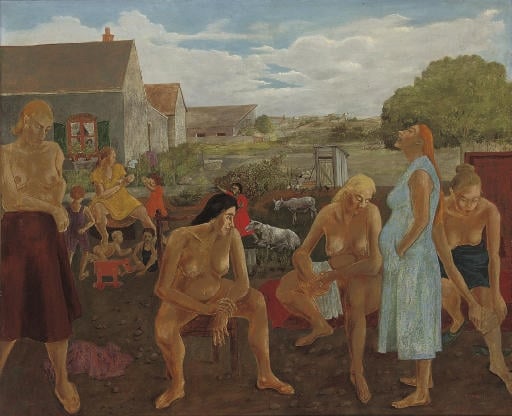
Les femmes enceintes
Expert analysis of Grégoire Michonze’s Les femmes enceintes
Style: Naïve Art (Primitivism) · Genre: nude painting (nu)
Expert Analysis: "Les femmes enceintes" (Pregnant Women) by Grégoire Michonze
Within the canon of Naïve Art (often grouped with Primitivism), Grégoire Michonze’s "Les femmes enceintes" stands as a masterful example of how the style can elevate the everyday into the symbolic. What makes this work significant is its daring, tender subversion of the traditional nude genre. In academic painting, the nude is typically idealized, eroticized, or heroic; here, Michonze centers the pregnant body—a form largely absent from classical nudes—and renders it with the straightforward, unassuming grace characteristic of Naïve aesthetics.
The painting’s importance lies in its fusion of stylistic innocence and thematic maturity. Naïve Art often relies on flattened perspective, bold outlines, and vibrant, unmodulated color. By applying these techniques to the subject of pregnant women, Michonze strips away any potential voyeurism or clinical detachment. Instead, the figures are presented with a childlike wonder that paradoxically honors the complexity of childbirth and femininity. The awkward, rounded forms—so unlike the linear perfection of Renaissance nudes—become a celebration of fertility and the natural body. This aligns with Primitivism's rejection of Western artistic conventions in favor of a more direct, emotional truth.
Furthermore, Michonze, a Romanian-born painter of the School of Paris, brought a distinct folk-art sensibility to his work. "Les femmes enceintes" likely reflects this cultural blending: the composition may feel dreamlike or slightly dislocated, yet the subject matter is universally human. In the context of Naïve Art, where painters like Henri Rousseau depicted jungles and fantasies, Michonze turns inward to the maternal. This work reminds us that the “primitive” gaze can be one of profound empathy, transforming a biological reality into a timeless, almost ritualistic icon. The piece is significant precisely because it claims a space for the pregnant nude—a subject marginalized in high art—and does so through a style that venerates sincerity over sophistication.
Visually similar
20 works with related composition and palette
Scene villageoise
Grégoire Michonze
Maternity (Three Women on the Seashore)
Paul Gauguin
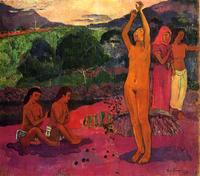
The Invocation
Paul Gauguin
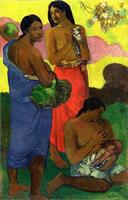
Maternite II
Paul Gauguin
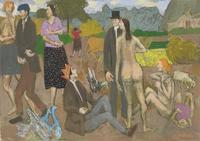
Scene de village aux oiseaux bleus
Grégoire Michonze
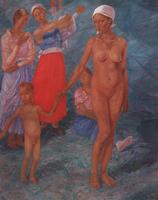
Morning: Women Bathing
Kuzma Petrov-Vodkin
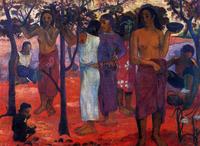
Perfect days
Paul Gauguin
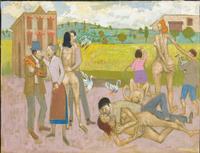
Scene de village
Grégoire Michonze
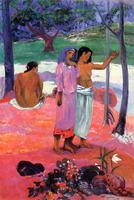
The Call
Paul Gauguin
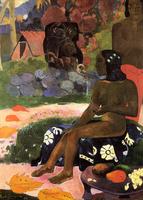
Her nami is Vairaumati
Paul Gauguin
First Steps
Kuzma Petrov-Vodkin
Bathers
Paul Gauguin
Two Girls in Landscape
Otto Mueller
Delectable Waters
Paul Gauguin
Sacred Spring
Paul Gauguin
Where are you going?
Paul Gauguin
Scene paysanne
Grégoire Michonze
Figures in a Landscape at Ampurdan
Salvador Dali
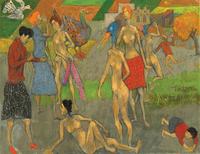
Women and Birds
Grégoire Michonze
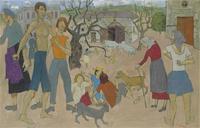
Village Street
Grégoire Michonze