
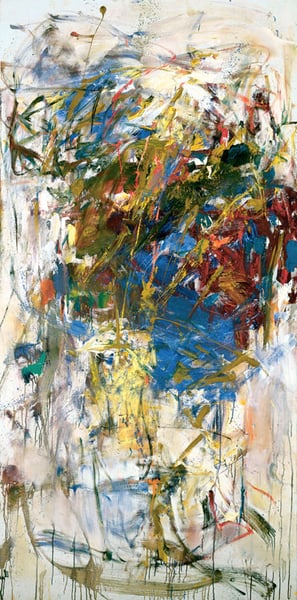
Expert analysis of Joan Mitchell’s Le Chemin des Ecoliers
Style: Abstract Expressionism · Genre: abstract
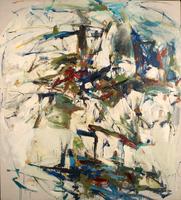
Joan Mitchell’s Le Chemin des Ecoliers (c. 1961) stands as a luminous exemplar of her early-career French period (1958–1968), when she began to distill the raw energy of American Abstract Expressionism into a more personal, lyrical vocabulary. The title, translating to “The Schoolchildren’s Path,” hints at a memory or sensation—perhaps a route from childhood or the landscape around her studio in Vétheuil—but remains firmly abstract, as Mitchell always insisted her works were about feeling, not illustration.
Formal Significance
Mitchell’s painting is a riot of controlled gesture. Broad, sweeping strokes of cerulean, emerald, and ochre collide with drips and smears of white and pink, creating a dense, calligraphic surface. Unlike the all-over compositions of Jackson Pollock, Mitchell’s marks often suggest a horizon or a spatial pull—here, a diagonal surge across the canvas mimics a path receding or advancing. The paint is both thickly impastoed and thinly washed, evidence of her urgent, physical process: she worked the canvas on the floor, walking around it, letting gravity and wrist action shape the gestures.
Contextual Significance within Abstract Expressionism
Mitchell was one of the few women to achieve critical acclaim in the male-dominated New York School, yet she rejected its heroic scale and angst. Le Chemin des Ecoliers instead embraces a more intimate, emotionally open approach. During her move to France, she absorbed the soft, silvery light of the Seine valley, which softened her earlier, more aggressive palette. Here, the hot pinks and yellows recall the dappled sun through leaves, while the blue-black slashes evoke shadows. This fusion of American action painting with French clarté (clarity or luminosity) marks a pivotal moment: Mitchell was forging a third way—neither pure gesture nor pure landscape, but a synesthetic record of a place felt rather than seen.
Why It Matters
Le Chemin des Ecoliers exemplifies Mitchell’s breakthrough into what critics later called “lyrical abstraction.” It demonstrates that Abstract Expressionism could be both visceral and elegant, raw and reflective. The painting prefigures her later, more monumental works (such as the Salut Tom series) while retaining the intimate scale and autobiographical whisper that distinguishes her early France period. In its tension between chaos and structure, memory and paint, it remains a key document of how a major artist translated the ineffable—a path, a childhood, a mood—into purely pictorial terms.
Visually similar
20 works with related composition and palette
La Chatiere
Joan Mitchell
Grandes Carrières
Joan Mitchell
Untitled
Joan Mitchell
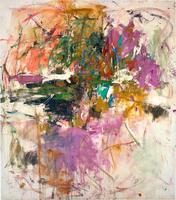
Untitled
Joan Mitchell
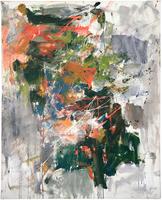
Untitled
Joan Mitchell
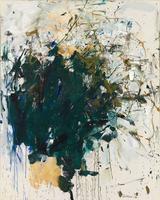
Untitled
Joan Mitchell
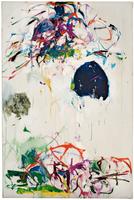
Untitled
Joan Mitchell
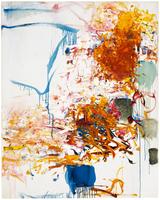
Untitled
Joan Mitchell
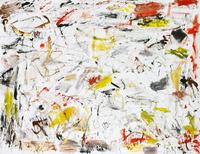
Une longue promenade
Aurel Cojan
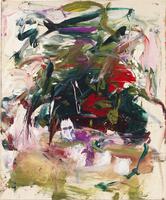
Untitled
Joan Mitchell
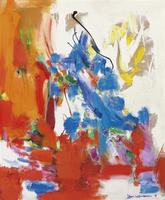
Wild Vine
Hans Hofmann
Hemlock
Joan Mitchell
Untitled
Joan Mitchell
Imrie
Mary Abbott
Vue sur la seine
Aurel Cojan
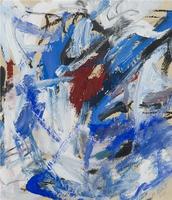
Abstrakter Expressionismus
Mary Abbott
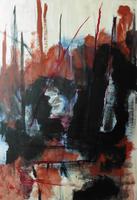
Sacrifice 1.
Ben Vollers
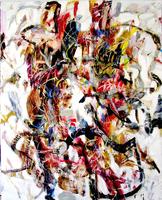
Ball Agenda II
Romul Nutiu
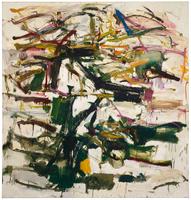
Untitled
Joan Mitchell
George Went Swimming at Barnes Hole, but It Got Too Cold
Joan Mitchell