Expertenanalyse zu John Hoylands The Gnome
Stil: Abstract Expressionism · Genre: abstract
Analysis of "The Gnome" by John Hoyland
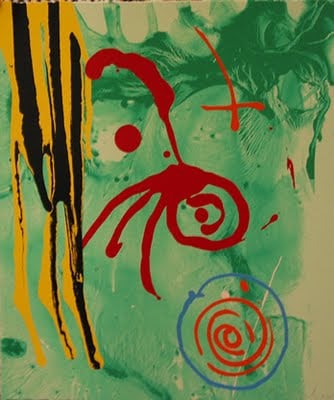
John Hoyland’s The Gnome stands as a compelling example of British Abstract Expressionism, a movement in which the artist was a pivotal figure. Unlike the more overtly gestural and angst-ridden works of American Abstract Expressionists, Hoyland’s practice emphasizes a bold, lyrical use of color and a structuring of abstract space that feels both energetic and deliberate. This work is significant for several reasons:
1. Mastery of Color as Subject: Hoyland was renowned for his ability to make color the primary emotional and structural driver of a composition. In The Gnome, we see his signature approach: flat, vibrant fields of color that interact dynamically with one another. The title, suggesting a playful, perhaps mythical figure, invites the viewer to find organic forms within the abstract shapes—a departure from pure non-objectivity and a nod to surrealist or symbolic undertones. This balance between pure abstraction and referential hinting was a hallmark of Hoyland’s mature period and distinguishes him within the broader Abstract Expressionist canon.
2. Gestural Control within Abstraction: While the work belongs to an abstract genre, Hoyland’s brushwork is neither chaotic nor fully automatic. The paint is applied with a controlled, rhythmic gesture that creates a sense of movement without losing compositional coherence. This reflects the British abstraction movement’s tendency toward more structured, color-field-oriented expressionism compared to the slashing brushstrokes of American counterparts. The “gnome” itself might emerge as a concentrated cluster of darker or more energetic marks amid broader washes, demonstrating Hoyland’s skill in anchoring a composition with a focal point within an otherwise expansive abstract field.
3. Significance in British Post-War Art: Hoyland came to prominence in the 1960s, a time when British art was dominated by Pop Art and figurative work. By championing a rigorous, non-figurative painterly language, he maintained the relevance of abstract expressionism in a changing art world. The Gnome represents his ongoing dialogue with the legacy of American Abstract Expressionists like Rothko and Pollock, but filtered through a distinctly British sensibility—more reserved, yet equally passionate about the sensory power of paint.
4. The Title’s Role: The decision to call a purely abstract painting The Gnome is significant. It invites narrative or anthropomorphic readings without imposing them, demonstrating how abstract works can evoke figurative associations through color and form. This play between abstraction and representation was a subtle but important contribution to the period’s discourse on the limits of non-objective art.
In summary, The Gnome is significant as a vivid testament to John Hoyland’s lifelong pursuit of color as both structure and emotion. It exemplifies how British Abstract Expressionism could be both rigorously abstract and whimsically evocative, affirming Hoyland’s place as a master of the genre.
Genre
Visuell ähnlich
20 Werke mit ähnlicher Komposition und Farbpalette
Composition on the black
Istvan Molnar
Cronos 8
Rene Duvillier
Ancient Universal Royals
Jack Armstrong
Yellow Boat (7.8.98)
John Hoyland
Pompey's Head
Paul Jenkins
Untitled
John Hoyland
Continental Divide
Paul Jenkins
Aerie
Helen Frankenthaler
Faiseurs d'emmerdes pour sur
Francois Arnal
Prince Patutsky Memoir: Turquoise and Yellow
Jules Olitski
Proximity of Bodies
Istvan Molnar
Sky Ritual
John Hoyland
Untitled
Ligia Macovei
Relative Tranquiliyi
Istvan Molnar
Flirt
Helen Frankenthaler
Taposiris magna
Mariojosé Ángeles
Uranus
Norman Bluhm
Number 251
Roger Weik
Cronos 29
Rene Duvillier
Untitled
Ligia Macovei