Analysis of "Critter with Mobile Top" by Alexander Calder
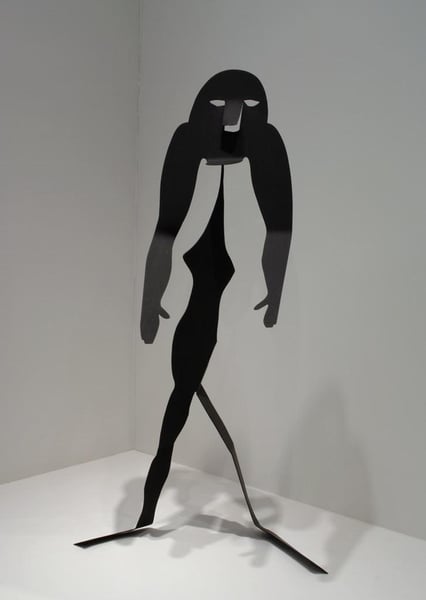
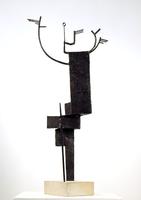
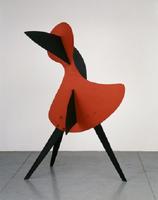
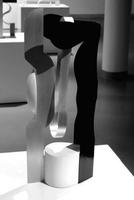
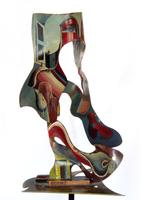
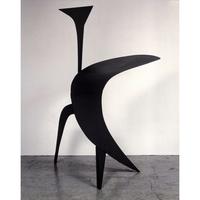
As a work from Calder's MONUMENTAL WORKS: 1963–1976 period, Critter with Mobile Top epitomizes the artist's mature synthesis of Kinetic Art principles with large-scale public sculpture. The piece belongs to the genre of stabile—a static, often abstract form—yet it subverts that stasis by incorporating a mobile top, a hallmark of Calder’s earlier hanging mobiles. This hybrid structure creates a dynamic tension between the grounded, monolithic base (the "critter" body) and the airy, slowly rotating upper elements. The significance lies in Calder’s ability to balance industrial permanence with delicate movement, transforming a fixed metal sculpture into an ever-changing composition that interacts with wind and light. By merging stabile and mobile into a single monumental form, Calder expanded the vocabulary of Kinetic Art, proving that motion could coexist with architectural scale without sacrificing formal integrity.