Analisi esperta di Running White di Ellsworth Kelly
Stile: Hard Edge Painting · Genere: abstract
Expert Art Historical Analysis: "Running White" by Ellsworth Kelly
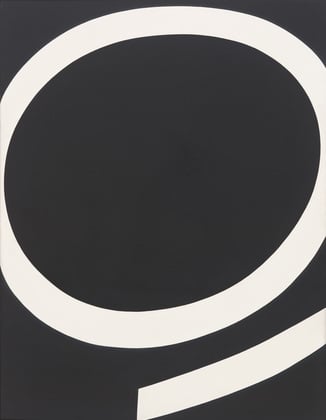
Ellsworth Kelly’s “Running White” stands as a quintessential example of Hard Edge Painting, a mid-20th-century movement that rejected the gestural spontaneity of Abstract Expressionism in favor of crisp boundaries, unmodulated color, and precise, simplified forms. Created within Kelly’s mature period, the work exemplifies his lifelong investigation of shape, perception, and the relationship between figure and ground.
Context within Hard Edge Painting
Emerging in the 1950s–60s, Hard Edge Painting emphasized clarity and anonymity of technique. Artists like Kelly, Frank Stella, and Kenneth Noland employed sharp contours, flat washes of color, and often asymmetrical compositions that stressed the physical flatness of the canvas. “Running White” embodies these principles: its contours are clean and unwavering, and the color is applied without brushstroke evidence, producing a cool, impersonal surface that directs attention solely to the interaction of shape and hue.
Analysis of the Work
True to its title, “Running White” likely features a white form that appears to move or slide across a contrasting colored field—or vice versa. The word “running” suggests a dynamic, almost fluid quality within the hard, static edges. This tension between motion and rigidity is a hallmark of Kelly’s work: he often derived shapes from observed objects (shadows, architectural fragments) but distilled them into pure biophilic or geometric abstractions. The white shape may be irregular or slightly asymmetrical, prompting the eye to follow its contour as if in motion. The background, likely a vibrant, saturated hue (Kelly frequently used red, blue, yellow, or black), activates the white form, making it appear to advance or recede. The result is a visual experience that is both precise and optically dynamic.
Significance in Kelly’s Oeuvre and Art History
- Pioneering Seriality and Perception: Kelly was among the first to use shaped canvases and to treat the entire field of vision as a unified, non-hierarchical plane. “Running White” continues his exploration of “figure/ground” ambiguity, where no element dominates; instead, color and shape coexist as equal parts of a single perceptual event.
- Expanding Abstraction: By excising gesture, narrative, and symbolism, Kelly’s Hard Edge works like “Running White” push abstraction toward a pure optical language. The work is significant because it demonstrates that abstraction can be deeply experiential—rooted in the literal act of seeing—rather than in emotion or representation.
- Legacy: “Running White” influences Minimalist and Post-Painterly Abstraction movements. Its commitment to flatness, edge, and reduction anticipates later work by artists such as Robert Ryman and Brice Marden, who similarly focused on the material and perceptual limits of painting.
In sum, “Running White” is significant not only as a masterful example of Hard Edge Painting but also as a pivotal work in Ellsworth Kelly’s career: it synthesizes his radical simplification with a subtle dynamism, proving that the most constrained visual vocabulary can generate profound, meditative engagement.
Visivamente simili
20 opere con composizione e palette affini

To Martha's Memory
Jiro Yoshihara
Shapin' Up
Leo Valledor
Untitled
Fernando Lanhas
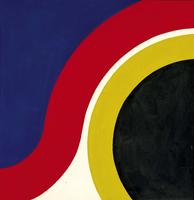
Red Span
Thomas Downing

E 129
Tadasky
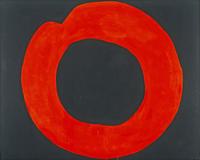
Red Circle on Black
Jiro Yoshihara
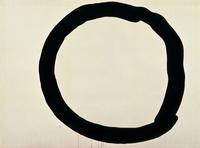
Work
Jiro Yoshihara
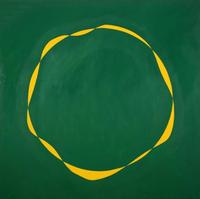
Garland
Jeremy Moon
Untitled
Verena Loewensberg
Black Variation IV, from Second Curve series
Ellsworth Kelly
Cadmium Orange of Doctor Frankenstein
Jules Olitski
Genesis
Virginia Jaramillo
Mao
Al Held
Earthen Bound
Kenneth Noland
Cleopatra Flesh
Jules Olitski
Untitled Abstract
Alexander Liberman

Untitled, from Sightlines
Wanda Koop
Untitled #9
Jules Olitski
Construction
Burgoyne Diller
SS 28-76
Nassos Daphnis