Análisis experto de The Crying Crocodile Tries to Catch the Sun de Karel Appel
Estilo: Art Informel · Género: figurative
Analysis of "The Crying Crocodile Tries to Catch the Sun" by Karel Appel
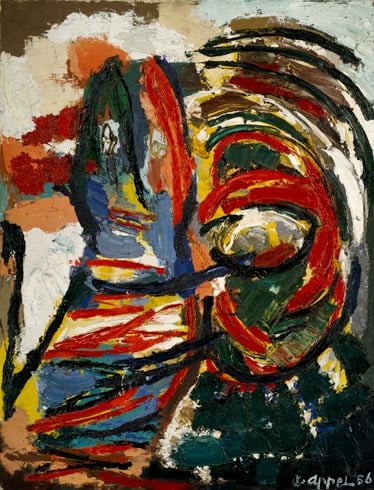
Within the context of Art Informel—a mid-20th-century European movement that rejected geometric abstraction and classical composition in favor of spontaneous, gestural expression—Karel Appel’s work stands as a visceral exemplar. This painting, with its provocative title and vividly figurative imagery, encapsulates the movement’s core values: raw emotion, primal energy, and a deliberate return to the untamed, childlike impulse.
Significance within Art Informel and the Figurative Genre
-
Embodied Gesture and Materiality
Appel, a founding member of the CoBrA group (whose experimentation directly fed into Art Informel), was known for applying paint with aggressive, almost violent immediacy. In The Crying Crocodile, thick impasto and sweeping brushstrokes likely dominate the surface, turning the act of painting into a physical event. This material intensity aligns Art Informel with the “art brut” ethos of Jean Dubuffet, valuing unrefined, raw expression over skillful representation. -
Primitivist Figuration
Though formally considered figurative, Appel’s crocodile is not a naturalistic portrait but a distorted, almost anthropomorphic creature. Its “crying” state and futile attempt to “catch the sun” evoke a universal, tragicomic struggle—a motif that echoes existentialist currents in postwar Europe. The figure becomes a surrogate for human anxiety, impulsiveness, and the absurdity of desire. This is figurative art stripped of academic polish, where the line between abstraction and representation blurs. -
Color and Emotional Intensity
Typical of Appel, a confrontational, high-contrast palette (likely including screaming yellows, deep blues, and muddy earth tones) would heighten the emotional charge. The sun—an archetypal symbol of life and unattainable power—is rendered with the same crude energy as the crocodile, preventing any sense of hierarchy. The entire composition feels like a battlefield of color and form, reinforcing the movement’s rejection of harmony and its embrace of dissonance. -
Narrative as Pretext, Not Prescription
The title provides a whimsical, childlike narrative, yet the painting’s impact lies not in storytelling but in the act of making. Like many Art Informel works, the image is a record of the artist’s psychic state in the moment of creation. The crying crocodile is less a specific character than a vehicle for expressing anguish, frustration, or wild joy. This tension between title and execution highlights the movement’s fascination with the irrational and the spontaneous.
Conclusion
The Crying Crocodile Tries to Catch the Sun embodies Art Informel’s radical break from tradition. Its significance rests on Appel’s ability to fuse primitive figuration with a raw, gestural technique, creating a work that is both emotionally direct and formally disruptive. The painting refuses to be consumed as mere decoration; it demands a reaction, much like the crying crocodile itself—a creature caught in an impossible, deeply human quest. This is Art Informel at its most potent: an unflinching, anti-intellectual celebration of the raw, the flawed, and the alive.
Género
Estilo
Visualmente similares
20 obras con composición y paleta relacionadas
L'infinie suffisance
Asger Jorn
Lever de soleil
Chaibia Talal
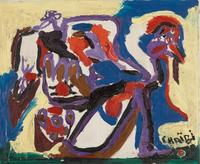
Bird (No. C.12)
Chaibia Talal
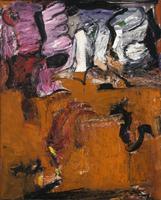
Pallas Athena--Earth
Grace Hartigan
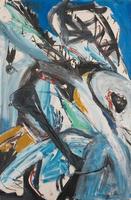
Untitled
Helmut Sturm
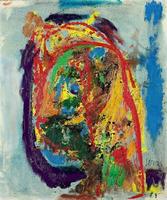
Oui, chérie
Asger Jorn
Untitled
Janet Sobel
Composition
Valerii Lamakh
An angel of the Last Judgement
Wassily Kandinsky
Jeux des formes
Serge Brignoni
Armageddon
Artin Demirci
Asheville
Willem de Kooning
Composition#2
Valerii Lamakh
Relógio
Mario Cesariny
The arrival of the bird
Corneille
Woman represented as a bird
George Ebrin Adingra
Sérénité Aubaine
Asger Jorn
Trees on a Cloudy Day
Vilen Barsky
Trees on a Cloudy Day
Vilen Barsky
Mi.R Bb16
MAURIZIO D'ANDREA