Clearing Back
Expert analysis of Nicolae Grigorescu’s Clearing Back
Style: Impressionism · Genre: landscape
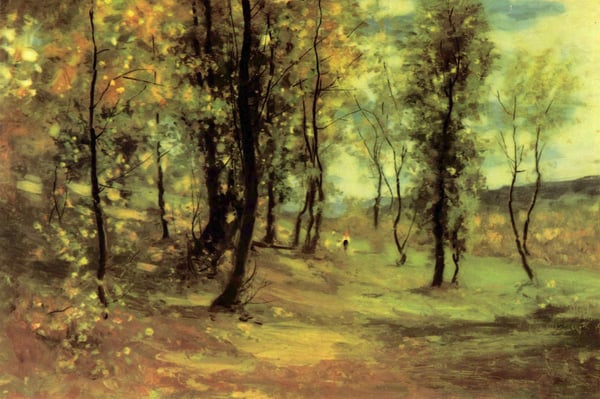
In "Clearing Back," Nicolae Grigorescu masterfully orchestrates a symphony of light and shadow that captures the ephemeral beauty of a forest interior. True to the Impressionist ethos, the painting prioritizes atmospheric vibration over rigid detail. The composition is dominated by the vertical rhythm of slender tree trunks, which frame a luminous clearing in the middle distance. Grigorescu utilizes a rapid, feathery brushstroke—a technique he refined during his time in France among the Barbizon painters and later the Impressionists—to dissolve the foliage into a shimmering haze of golds, ochres, and soft greens. This approach creates a sense of movement, suggesting a gentle breeze rustling through the canopy and dappling the forest floor with shifting patches of sunlight.
Historically, this work is a testament to Grigorescu’s pivotal role as the father of modern Romanian painting. He was instrumental in moving Romanian art away from stiff academic formalism toward plein air painting (painting outdoors to capture natural light). "Clearing Back" exemplifies his synthesis of Western European techniques with a distinctly Romanian sensibility. While the technique mirrors the works of Corot or Renoir, the atmosphere is intimately tied to the Romanian landscape. The inclusion of the small, indistinct figure—likely a peasant—wandering through the glade is a signature motif for Grigorescu. It serves not merely to provide scale, but to symbolize the harmonious, timeless bond between the Romanian peasant and the land.
The artwork’s significance lies in its ability to transform a mundane woodland scene into a poetic visual experience. The "clearing" of the title acts as a focal point of hope and clarity amidst the darker, denser foreground, guiding the viewer’s eye toward the light. By blurring the edges of the forms, Grigorescu invites the viewer to complete the image with their own imagination, engaging with the memory of a forest rather than a botanical study of one. The painting stands as a lyrical celebration of nature, capturing a fleeting moment of tranquility where light serves as the primary subject matter.
Visually similar
20 works with related composition and palette
Edge of a Wood
Vincent van Gogh
Autumn Forest
Max Slevogt
View of the Villa Borthese
Gustave Moreau
The Picnic
Willard Metcalf
The Path through the Forest
Pierre-Auguste Renoir
Donkey by lane
Paul Gauguin
Young oaks
Pyotr Konchalovsky
Landscape
Camille Corot
In the forest Saint Cloud II
Paul Gauguin
Landscape in the Sun
Pierre-Auguste Renoir
Landscape
Joan Brull
Souvenir of Italy
Camille Corot
Landscape With Trees
Joan Brull
Forest Vista
Stefan Popescu
First Leaves, near Nantes
Camille Corot
Path in the forest
Isaac Levitan
Study of trees
Edouard Manet
The Forest Path
Paul Gauguin
Sunny Landscape
Pierre-Auguste Renoir
Autumn forest
Isaac Levitan