
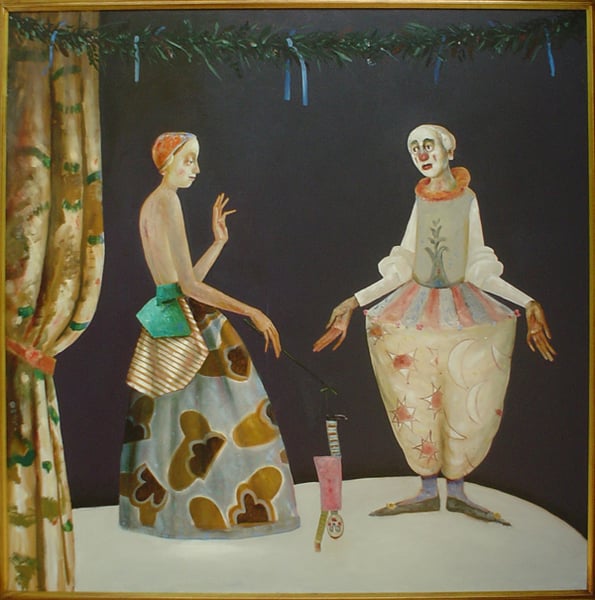
Analisi esperta di Puppeteer and White Clown di Stefan Caltia
Stile: Magic Realism · Genere: genre painting
Expert Analysis: "Puppeteer and White Clown" by Stefan Caltia
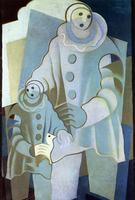
Stefan Caltia’s “Puppeteer and White Clown” is a compelling example of Magic Realism as applied to genre painting, a combination that elevates an ostensibly ordinary scene into a space of psychological depth and quiet strangeness. While the work is not described in physical detail here, its very title and stylistic classification signal how it achieves significance within its art-historical context.
Magic Realism is distinguished by its fusion of meticulous, almost hyper-realistic representation with an undercurrent of the uncanny or the magical. In this painting, the familiar subject matter of a puppeteer and a clown—traditional figures of performance and spectacle—is rendered with the precision of a Dutch still life, yet the viewer is subtly unsettled. The “white clown” (typically a more sad, refined, or mysterious character in circus tradition, as opposed to the comic Auguste) and the puppeteer (a literal manipulator of figures) create a meta-theatrical dialectic: who is truly controlling whom? This ambiguity taps into Magic Realism’s core impulse to question reality, perception, and agency.
As a genre painting, “Puppeteer and White Clown” follows the tradition of depicting everyday life, but Caltia imbues that life with a dreamlike pause. The scene likely captures a backstage or idle moment—not a performance in action, but a suspended instant where the puppets and performers seem to exist in their own enigmatic world. This stillness is a hallmark of Magic Realist genre painting, where the ordinary is rendered extraordinary through inflection rather than overt fantasy.
Significance: The work is significant because it demonstrates how Magic Realism can renew the ancient genre of performance painting. Rather than a bustling carnival scene (as in Daumier or Seurat), Caltia isolates two archetypal figures—the manipulator and the manipulated—and freezes them in a state of mutual contemplation. The painting likely invites questions about artistry, identity, and the thin line between spontaneous life and controlled artifice. In doing so, it aligns with Magic Realism’s broader project: to reveal the wondrous hidden within the mundane, and to remind us that even the most familiar stage may harbor a silent, profound mystery.
Visivamente simili
20 opere con composizione e palette affini
Woman Seated in Front of Portrait
Jean Dupas
Cabaret
Sandor Bortnyik
A panic in the Middle Ages
Rene Magritte
Untitled
Corneliu Michailescu
A Nocturne of Chopin
Aubrey Beardsley
Character with Cup
Stefan Caltia
Girl With Lemon
Stefan Caltia
Las Meninas (Velazquez)
Pablo Picasso
Street Dancer. Costume design
Alexandre Benois
Pierrot (with Serpent)
Heinrich Campendonk
Ballet of Marionettes II
Aubrey Beardsley
Don Quichotte: Les duegnes
Bernard Buffet
Shepherds and Shepherdess
Serge Sudeikin
Self-Portraits (Harlequin and Pierrot) - with Vasiliy Shukhaev
Alexandre Jacovleff
Women's costume for the Spanish dance
Aleksandra Ekster
Portrait of duchess Katharina von Mecklenburg
Lucas Cranach the Elder
Maschere No 1
Alberto Magnelli
Mademoiselle de Maupin
Aubrey Beardsley
Girl With Crown
Stefan Caltia
Two Pierrots
Juan Gris