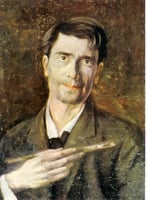
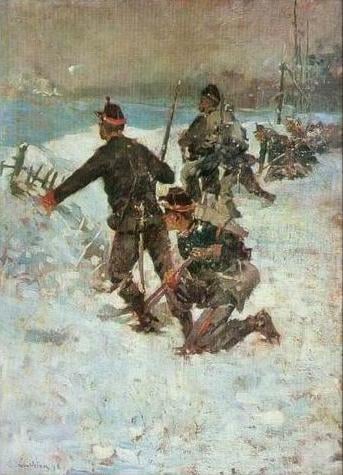
Come on, guys
Expertenanalyse zu Stefan Luchians Come on, guys
Stil: Impressionism · Genre: battle painting
Expert Analysis: “Come on, guys” by Ștefan Luchian
Ștefan Luchian’s “Come on, guys” stands as a remarkable and unexpected fusion within the history of Impressionism. While the movement is most often associated with dappled light, leisurely scenes, and urban or rural modernity, Luchian here transposes its core techniques onto the historically weighty genre of battle painting. This combination alone marks the work as significant: it challenges the conventional boundaries of Impressionist subject matter, proving that the style’s focus on transient light and fleeting moments could be applied to the chaos and human drama of conflict.
Stylistic Innovation within a Martial Frame
Luchian employs the hallmark Impressionist vocabulary—short, broken brushstrokes, a high-key palette, and a focus on atmospheric effects—to render the heat and dust of combat. Instead of the dark, dramatic chiaroscuro typical of academic battle paintings, he likely uses vibrant contrasts of sunlight and shadow, painting the scene as an instantaneous “impression” of a charge or skirmish. The title “Come on, guys” suggests a moment of rallying, a burst of collective movement captured as if through a snapshot—a distinctly Impressionist approach to a traditionally static, heroic genre.
Genre Inversion: The Intimate Epic
Most battle paintings of the 19th century (by artists like Meissonier or Vereshchagin) were grand, moralizing, or meticulously detailed. Luchian flips this: he prioritizes the sensory experience—the shimmer of uniforms, the blur of motion, the heat of the moment—over narrative or historical accuracy. This democratizes the battlefield, shifting focus from generals and grand strategies to the shared, visceral energy of soldiers. The work thus becomes a bridge between the epic tradition and the modernist subjectivity of Impressionism, where perception itself is the true subject.
Significance in Art History
“Come on, guys” is significant because it expands the geographic and thematic reach of Impressionism. Luchian, a leading figure of Romanian Impressionism, demonstrates that the movement was not merely a French phenomenon but a adaptable language for artists across Europe. By applying it to battle painting—a genre deeply associated with national identity and historical memory—he also asserts that even the most serious subjects can be rendered with the freshness and immediacy of Impressionist observation. This work remains a compelling testament to the versatility of Impressionist techniques and a unique contribution to the genre of war art.
Visuell ähnlich
20 Werke mit ähnlicher Komposition und Farbpalette
Military figures saluting
Alphonse-Marie-Adolphe de Neuville
The ambush
Alekos Kontopoulos
Snowy trenches (Russian position on the Shipka Pass)
Vasily Vereshchagin
Smârdan Attack
Nicolae Grigorescu
The onset of chain
Ivan Vladimirov
Counterattack
Ivan Vladimirov
Sketch for the battle of Varese
Federico Faruffini
From the artist's diary, the War 1904-1905
Mykola Samokysh
Sergent major de chasseur à pied
Alphonse-Marie-Adolphe de Neuville
The shooting in Presnya in December 1905
Ivan Vladimirov
Study to "The Conquest of Siberia by Yermak"
Vasily Surikov
Military clash
Ivan Vladimirov
Pogrom of wine shop
Ivan Vladimirov
The Execution of Varlin
Maximilien Luce
Winners
Vasily Vereshchagin
Soldiers in the snow
Vasily Vereshchagin
The Marines on the Fight at the Leningrad Front in January 1941
Veniamin Kremer
Straight across the lines
Etienne-Prosper Berne-Bellecour
Kronprinz Friedrich Wilhelm Von Preußen Während Der Schlacht Von Sedan
Emil Hünten
2nd Oxfordshire and Buckinghamshire Light Infantry Fight the Prussian Guard at the Battle of Nonne Bosschen, 11 November 1914
William Barnes Wollen