Janos Mattis-Teutsch sanatçısının Mattis Teutsch's Birthplace eseri hakkında uzman analizi
Tarz: Fauvism · Tür: landscape
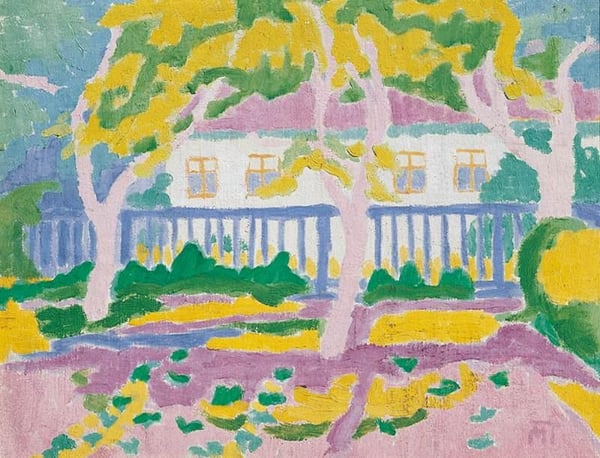
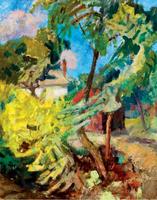
Expert Analysis: "Mattis Teutsch's Birthplace" by János Mattis-Teutsch
This work is a compelling example of Fauvist landscape painting, distinguished by its fusion of the movement’s characteristic visual rebellion with deeply personal, autobiographical content. Painted by the Hungarian-Romanian modernist János Mattis-Teutsch, the piece transforms a specific, intimate locale—the artist’s own birthplace—into a universal expression of emotional and sensory intensity.
Significance within Fauvism and the Landscape Genre
Fauvism, as a style, prioritizes pure, unmodulated color and expressive distortion over naturalistic representation. In "Mattis Teutsch's Birthplace," this translates into a radical reimagining of the artist’s native environment. The landscape is not a literal topographical record but a subjective, almost spiritual transcription of memory and feeling. The typical Fauvist palette—vivid, often non-localized hues—is employed to convey the emotional resonance of home. Trees, roofs, and sky are likely rendered in clashing or saturated tones, rejecting conventional shading in favor of flat, energetic planes of color that evoke a sense of primal vitality.
What makes this artwork particularly significant is how it personalizes the Fauvist idiom. While many Fauves (like Matisse or Derain) depicted generic scenes of southern France or urban views, Mattis-Teutsch anchors the movement’s radical chromatic freedom to a specific biographical anchor. By choosing his birthplace as subject, he infuses the landscape with a nostalgic, almost sacred quality. The viewer is not just seeing a house or a village but experiencing the artist’s own origin story through the lens of Fauvism’s liberation from optical truth.
Contribution to Mattis-Teutsch’s Oeuvre and Modernism
János Mattis-Teutsch occupied a unique position between Hungarian, Romanian, and Western European avant-garde currents. This painting bridges the emotional expressiveness of Central European modernism with the formal breakthroughs of early 20th-century French painting. The work’s significance lies in its demonstration that Fauvism was not merely a Parisian phenomenon but a flexible, international tool for expressing deep personal and cultural identity. In "Mattis Teutsch's Birthplace," the landscape becomes a symbol of rootedness, yet its execution is fiercely modern—proof that one can honor one’s past while embracing artistic revolution.
In summary, this artwork matters because it reframes a familiar genre through a highly individual lens, proving that Fauvism could be both a vehicle for universal color-emotion and a means of articulating personal history. It stands as a testament to the movement’s enduring power to transform the ordinary into the extraordinary.
Görsel olarak benzer
İlişkili kompozisyon ve renk paletine sahip 20 eser
Landscape
Arman Manookian
Blumengarten
Cuno Amiet
The Fence at Marnat
Émilie Charmy
Berény Róbert, Beszélgetők
Berény Róbert
Veules-les-Roses
Samuel Peploe
Marnat
Émilie Charmy
Landscape
Valerii Lamakh
Landscape
Vasiliy Ryabchenko
Bauerngarten
Cuno Amiet
Czóbel Béla Kapu
Bela Czobel
Garden Gate
August Macke
Berény Róbert , Tájkép,
Berény Róbert
VIEW OF A GARDEN
Benjamin Brown
Egry József, Park 1910
Egry József
Garden overlooking Oschwand
Cuno Amiet
Berény Róbert Kertben Sétáló
Berény Róbert
Csendélet Zöld Ajtó Elött
Bela Czobel
Bela Czobel, 1920 Lombok Közt
Bela Czobel
Berény Róbert, Kilátáts a Kertre
Berény Róbert
Going Home
Charles Blackman