
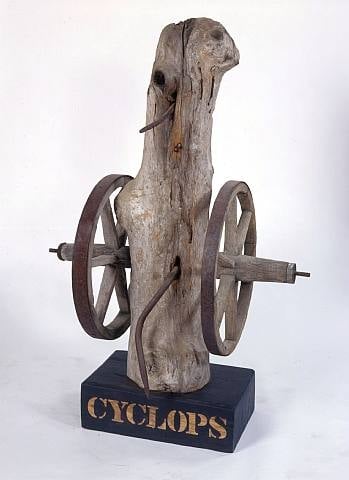
Analisi esperta di Cyclops di Robert Indiana
Stile: Neo-Dada · Genere: sculpture
Expert Analysis: "Cyclops" by Robert Indiana
Robert Indiana’s Cyclops (a sculpture in the Neo-Dada style) is a striking synthesis of pop-inflected assemblage and Dadaist irreverence, embodying the movement’s core impulse to challenge conventional art hierarchies. As a Neo-Dada work, it shares the original Dada movement’s love of absurd juxtaposition and found-object logic, yet updates it with the crisp, commercial vocabulary of 1960s American culture.
Significance within Neo-Dada and the Sculptural Genre:
-
Iconic Minimalism with a Twist: Like many Neo-Dada works, Cyclops reduces a recognizable form—here, the mythical one-eyed giant—to its barest geometric essentials. The sculpture likely employs Indiana’s signature hard-edged, stencil-like shapes and vivid, flat colors, blurring the line between fine art, signage, and industrial fabrication. This flattening of a classical figure into a logo-like icon mirrors Neo-Dada’s fascination with mass-media imagery and the deadpan presentation of everyday symbols.
-
Linguistic and Visual Pun: Indiana frequently incorporated text and wordplay into his art (e.g., LOVE, HOPE). The title Cyclops itself may function as a visual–verbal pun: a single “eye” becomes a single “I” (the self), or a critique of single-minded perception. The sculpture’s form likely plays on this duality, using a single circular motif (the cyclops’ eye) as the focal point, turning a mythological monster into a witty, coolly detached emblem of modern vision.
-
Challenging Sculptural Conventions: As a Neo-Dada sculpture, Cyclops rejects traditional carving or modeling in favor of constructed, often prefabricated elements. It stands as a critique of the heroic, expressionist sculpture of the previous generation, replacing it with an anonymous, mechanical aesthetic. This aligns with Robert Indiana’s broader project of creating “sculptural signs” that function as both object and symbol, existing somewhere between art, advertising, and linguistic sign.
-
Cultural Resonance: The cyclops is a figure of solitary, brute power; Indiana’s Neo-Dada version critiques that power by reducing it to a simple, almost toy-like form. The work’s significance lies in how it drains a myth of its menace and re-presents it as a cool, legible sign—a hallmark of Neo-Dada’s ironic, anti-heroic stance.
Conclusion: Cyclops is not merely a sculpture of a monster; it is a monument to the Neo-Dada method—transforming high culture into low, mythology into graphic design, and art into a blunt, witty statement about perception itself.
Visivamente simili
20 opere con composizione e palette affini
Mars
Robert Indiana
Law
Robert Indiana
Small Sailors' Home
Kurt Schwitters
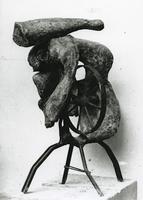
Pauper
Alina Szapocznikow
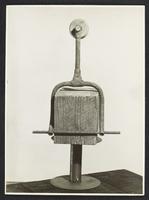
Clown tight rope walker
Louise Nevelson
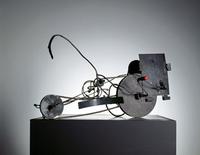
Méta-Matic No. 14
Jean Tinguely
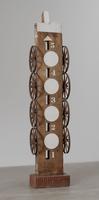
Moon
Robert Indiana
School of the Slip
Robert Indiana
Suzuki (Hiroshima)
Jean Tinguely
Magnet
Geta Bratescu
Konstruktion
James Licini
Construction for Noble Ladies
Kurt Schwitters
Char MK
Jean Tinguely
Tu y yo
Mathias Goeritz
Sketches of the machines
Filippo Brunelleschi
Sketches of the machines
Filippo Brunelleschi

Bob's Column
Robert Indiana
Monument to Heroes
Noguchi Isamu
A1
Ara Shiraz
Cathedral
Elsa von Freytag-Loringhoven