
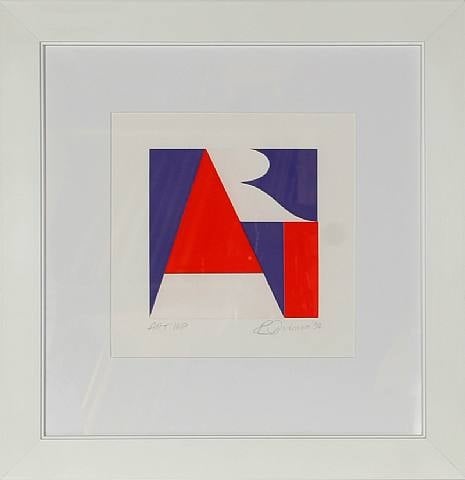
Analisi esperta di The American Art di Robert Indiana
Stile: Pop Art · Genere: figurative
The artwork The American Art by Robert Indiana is a quintessential example of Pop Art, a movement that emerged in the mid-20th century by drawing on imagery from popular culture, advertising, and mass media. Indiana’s work is significant within this style and period for several reasons, all supported by the given facts (Style: Pop Art, Genre: figurative).
First, as a figurative Pop Art piece, The American Art departs from the abstract expressionism that dominated the art world in the preceding decades. Indiana replaces traditional painterly abstraction with bold, flat, and hard-edged graphic forms—a hallmark of Pop Art that echoes commercial signage and billboard design. This move makes the work accessible and directly communicative, aligning with Pop Art’s goal of bridging “high” art and everyday life.
Second, the title itself—The American Art—functions as both subject matter and critique. Indiana frequently used words and numbers as his primary “figures,” transforming typography into iconic, almost heraldic symbols. In this work, the phrase becomes a figurative portrait of American identity, paradoxically both patriotic and questioning. Pop Art often celebrated or critiqued consumer culture; Indiana’s focus on the word “American” places the work firmly in a dialogue about nationalism, mass-produced imagery, and the commodification of national symbols.
Third, the work’s significance lies in its reduction and repetition. Indiana’s signature style involves isolating a single word or phrase (like “LOVE,” “EAT,” or “DIE”) within a compressed, emblematic format. The American Art likely employs similar strategies, using a bold, sans-serif typeface and bright, unmodulated colors (typically red, white, blue, or black). This repetition of form and idea makes the work instantly recognizable—a key Pop Art goal—while also suggesting the relentless replication of American ideals in media and advertising.
In summary, The American Art is a significant Pop Art work because it exemplifies the movement’s shift toward figurative, text-based imagery; it uses a recognizably American motif to examine national identity; and it employs the hard-edged, commercial aesthetic that defines Indiana’s contribution to Pop Art’s commentary on modern life.
Visivamente simili
20 opere con composizione e palette affini

Green Composition
Larry Zox
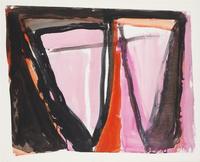
Composition
Bram van Velde
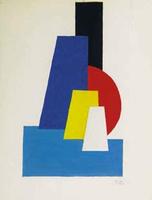
Untitled
Marcelle Cahn
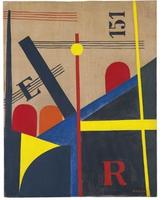
Large painting of the railroad
Laszlo Moholy-Nagy
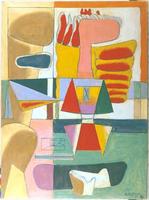
Adieu Von
Le Corbusier
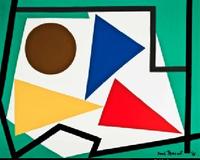
Abstract 4
René Marcil
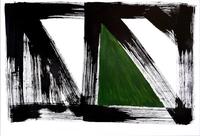
Untitled
Amilcar de Castro
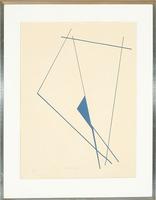
Composition (From the ”Nice” series)
Richard Mortensen
Ocidente
Nadir Afonso
Sign I
Pablo Palazuelo
Espaces concertés
Francis Bott
Painterly Architectonic
Lyubov Popova
Bourgogne
Richard Mortensen
Kiel
Richard Mortensen
Bulwark No. 1
Alberto Magnelli
Big Grey
Will Barnet
Synchromy in Dark Blue
Auguste Herbin
Composition
Cesar Domela
Abstract composition
Bart van der Leck
Composition 39
Stefan Sevastre