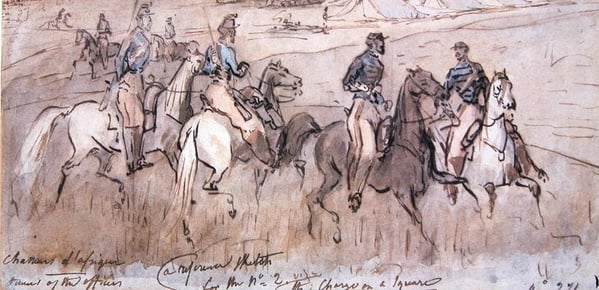
The Chasseurs d'Afrique during the Crimean War of 1854
Analisi esperta di The Chasseurs d'Afrique during the Crimean War of 1854 di Constantin Guys
Stile: Realism · Genere: genre painting
Expert Art Historical Analysis: "The Chasseurs d'Afrique during the Crimean War of 1854" by Constantin Guys
Constantin Guys’s The Chasseurs d'Afrique during the Crimean War of 1854 stands as a quintessential example of Realist genre painting that captures the unheroic, immediate texture of modern military life. Unlike the official battle paintings of the era—which often glorified commanders and monumentalized victory—Guys focuses on the everyday reality of soldiers on campaign, in this case the French light cavalry known as the Chasseurs d’Afrique.
The artwork’s significance within the Realist movement lies in its journalistic immediacy and anti-academic approach. Guys was celebrated by the poet and critic Charles Baudelaire as “the painter of modern life,” precisely because he recorded contemporary scenes with rapid, spontaneous linework and an unidealized eye. Here, instead of a dramatic charge or a heroic death, Guys depicts the mundane yet telling moment of soldiers maneuvering or resting—likely near the siege of Sevastopol. The horses, equipment, and terrain are rendered with truthful observation rather than classical proportion, reflecting Realism’s core tenet: to depict the world as it is, without rhetorical embellishment.
As a genre painting, the work elevates a brief, unglamorous episode to the level of historical record. It resists the grand narrative of war in favor of the faits divers (minor news items) that Baudelaire admired. Guys’s use of rapid washes and ink, often executed on the spot, gives the composition a sense of fleeting authenticity—as if the viewer is glimpsing a momentary pause in the campaign. This approach prefigures both the later Impressionist interest in everyday subject matter and the modern war correspondent’s visual journalism.
In summary, The Chasseurs d'Afrique during the Crimean War of 1854 is significant for its pioneering application of Realist principles to military genre painting, transforming a specific moment of the Crimean War into a universal meditation on the ordinary grit of soldiering. It exemplifies how Guys, through his attentive eye and anti-heroic tone, helped redefine the boundaries of historical and contemporary art.
Visivamente simili
20 opere con composizione e palette affini
Le duc d'Angoulême à cheval avec d'autres cavaliers
Horace Vernet
Charge of the Light Brigade Balaclava 25 October in 1854
Richard Caton Woodville Jr.
Napoleon Watching The Battle Of Friedland in 1807
James Alexander Walker
Giving the Orders
Emil Hünten
The battle of Friedland
Ernest Meissonier
The Advance
Frederic Remington
Napoleon at Jena
Ernest Meissonier
Mounted Artilleryman Leading Three Horses
Carle Vernet
The Gallant Charge of the Kentucky Cavalry Under Col. Marshall
Currier and Ives
The Fray of Battle
James Alexander Walker
General Von Bellegarde and His Officers Observing a Battle
Albrecht Adam
Independence or Death! (The Ipiranga Shout)
Pedro Américo
Battles of the British Army, Waterloo (1815)
Richard Caton Woodville Jr.
The Two Friends
Ernest Meissonier
Part of a Series Chronicling the Uniforms of Napoleon's Grande Armée.
Carle Vernet
Hussar, Russian Guard Corps
Frederic Remington
Battles of the British Army: Talavera (1809), Charge of the 23rd Dragoons against the French Squares
Richard Caton Woodville Jr.
Battle
Aime Morot
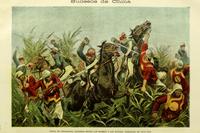
The Fighting Round Tientsin - Charge of the Japanese Cavalry
Richard Caton Woodville Jr.
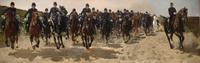
Cavalry
G H Breitner