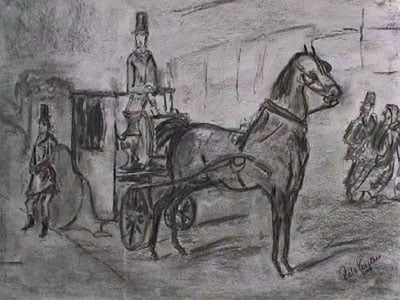
Voiture
Expert analysis of Constantin Guys’s Voiture
Style: Realism · Genre: genre painting
Expert Analysis: "Voiture" by Constantin Guys
Artist & Context:
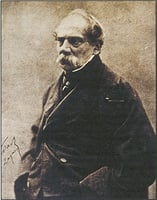
Constantin Guys (1802–1892) was a French artist celebrated for his spontaneous depictions of contemporary urban life. He was famously championed by poet-critic Charles Baudelaire, who called him the "painter of modern life." Guys worked primarily in watercolor, ink, and wash, capturing the fleeting moments of mid-19th-century Paris with a reporter’s eye and a sketch-like immediacy.
Style & Genre:
"Voiture" (French for "carriage" or "vehicle") is a genre painting executed in the Realist tradition. Realism in the 1850s–1860s rejected idealized history painting and exotic romanticism, instead focusing on the ordinary, the transient, and the unvarnished truth of modern existence. Genre painting—scenes of everyday life—was a perfect vehicle for this approach, and Guys made it his specialty.
Significance:
- Capturing Modernity on the Move: "Voiture" epitomizes Guys’ ability to distill the energetic flux of Parisian streets. The carriage—a symbol of both mobility and social status—is rendered with swift, fluid strokes that convey motion, dust, and the bustle of city life. Unlike the polished finish of academic painting, Guys’ technique (often using ink wash with touches of color) feels instantaneous, as if the scene were glimpsed and recorded in a single breath.
- Baudelairean "Heroism of Modern Life": For Baudelaire, Guys’ work was heroic because it found beauty in the ephemeral—the flutter of a dress, the gleam of a carriage lamp, the anonymous figures passing by. "Voiture" is not merely a depiction of a vehicle but a fragment of the modern spectacle: a snapshot of Paris in transition, with its classes, commerce, and rhythms.
- Influence on Impressionism: Guys’ emphasis on immediacy, atmospheric effects, and everyday subjects anticipated the Impressionists’ outdoor scenes and fragmented brushwork. Degas and Manet admired his ability to seize a moment without academic pretense. In this context, "Voiture" stands as a precursor to the modern fascination with the transient visual experience of the city.
In Summary:
"Voiture" is significant for its documentary-realist approach to modern life, its deft suggestion of motion and atmosphere, and its role in defining a new artistic attitude: one that found artistic greatness not in history or myth, but in the everyday pageant of the street. Guys’ work remains a vital record of 19th-century Paris and a cornerstone of the Realist movement’s commitment to truth and contemporary experience.
Visually similar
20 works with related composition and palette
Dandies in the Park
Constantin Guys
Przejażdżka
Piotr Michałowski
Dyliżans Francuski
Piotr Michałowski
Horse-drawn Carriage in Rome
Fujishima Takeji
Under the rain by the coach to Black River
Vasily Surikov
White tavern
Niko Pirosmani
Nice, on the Promenade des Anglais
Henri de Toulouse-Lautrec
Carriage and Three Gentlemen on Horses
Constantin Guys
Ekwipaż przed pałacem Wielopolskich
Piotr Michałowski
Dog Car
Henri de Toulouse-Lautrec
Scheiber Hugó, Konflis
Scheiber Hugó
A mail coach and four
Charles Cooper Henderson
The Celebrated Four in Hand Stallion Team
Currier and Ives
Scheiber Hugó, Éjszakai Kocsikázás
Scheiber Hugó
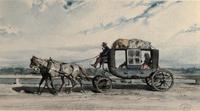
Carriage from Vienna to Klosterneuburg
August von Pettenkofen
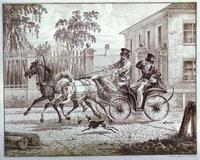
Town Carriage (Droshky)
Alexander Orlowski
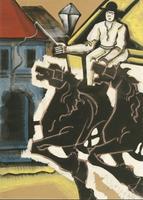
Scheiber Hugó, Konflis,.
Scheiber Hugó
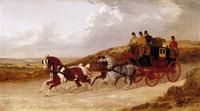
The Edinburgh and London Royal Mail
John Frederick Herring Sr.
Scheiber Hugó, Konfliss,. ,
Scheiber Hugó
Scheiber Hugó, Konlis, Olaj,papír,
Scheiber Hugó