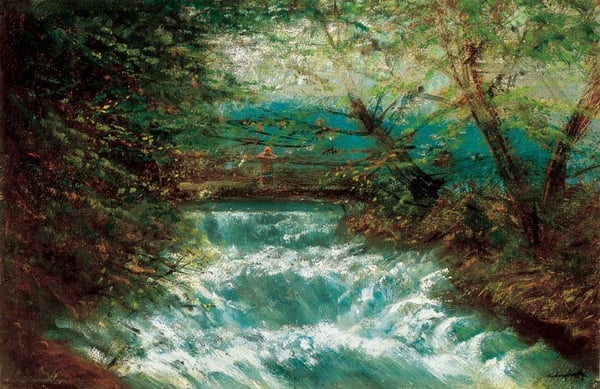
Burring Brook
Analisi esperta di Burring Brook di Laszlo Mednyanszky
Stile: Impressionism · Genere: landscape
Expert Analysis of "Burring Brook" by Laszlo Mednyanszky
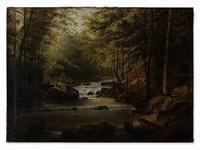
Laszlo Mednyanszky’s "Burring Brook" exemplifies the quiet, lyrical side of Hungarian Impressionism, a movement that often married the French fascination with light and atmosphere with a distinctly Central European sensitivity to mood and solitude. As an Impressionist landscape, the work focuses not on the drama of nature but on its ephemeral, sensory qualities—the shimmer of water, the dappled play of sunlight through foliage, and the elusive boundary between solid forms and their reflections.
Significance within Impressionism
Mednyanszky’s contribution lies in his ability to infuse the Impressionist idiom with a meditative, almost melancholic tone. While many French Impressionists celebrated the vibrancy of everyday life, Mednyanszky frequently chose secluded, unpopulated scenes—like this brook—that suggest a quiet reverence for the natural world. The brushwork in "Burring Brook" is likely loose and broken, applied in short, rhythmic strokes that convey the sparkle of moving water and the soft blur of overhanging branches. This technique aligns with the Impressionist goal of capturing a fleeting moment, yet Mednyanszky’s palette often leans toward muted greens, silvery grays, and autumnal ochres, creating a hushed, introspective atmosphere rather than the brilliant sunshine of Monet or Renoir.
Significance within Mednyanszky’s Oeuvre and Hungarian Art
Mednyanszky is renowned for his ability to render the spiritual essence of landscapes, particularly watercourses. "Burring Brook" stands out as a masterful study of movement and reflection—the brook’s “burring” sound (suggested by the title) is translated visually into cascading highlights and broken contours. This painting also reflects his fascination with the interplay of light and shadow in forest interiors, a theme that links him to the Barbizon school’s influence and to later Hungarian Post-Impressionists. In the context of late 19th-century Hungarian art, Mednyanszky’s landscapes helped shift national painting away from Romantic heroicism toward a more intimate, subjective naturalism, paving the way for modernist explorations of perception.
Conclusion
"Burring Brook" is significant not only as a pristine example of Impressionist technique—with its emphasis on atmosphere, color harmony, and the dissolution of form—but also as a testament to Mednyanszky’s unique voice within the movement. It captures something inherently Hungarian: a brook that is less a named location and more a sacred space of water, light, and silence, inviting the viewer into a contemplative immersion in nature’s transient beauty.
Visivamente simili
20 opere con composizione e palette affini
Burring Brook with Bridge
Laszlo Mednyanszky
A Derbyshire Brook
Thomas Stuart Smith
Autumn Wood
William Hart
Forest with water lilies
Silvestro Lega
The Moriston River
John Henderson
Landscape with a River
Thomas Stuart Smith
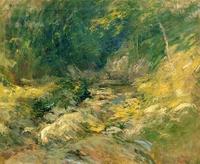
The Hidden Pool
John Henry Twachtman
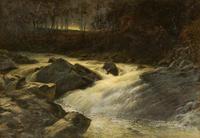
The Feugh
Joseph Farquharson
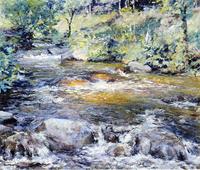
The Brook
Robert Lewis Reid
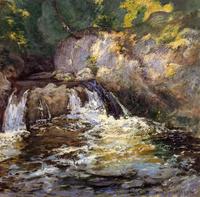
Waterfall
John Henry Twachtman
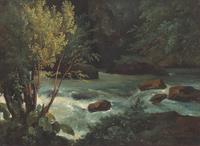
Stream in Auvergne near Royat
Theodore Rousseau
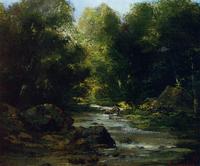
River Landscape
Gustave Courbet
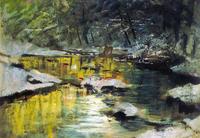
Melting of Snow
Laszlo Mednyanszky
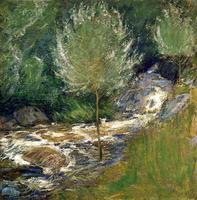
The Brook, Greenwich, Connecticut (aka Horseneck Falls, Greenwich, Connecticut)
John Henry Twachtman
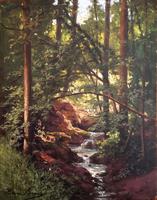
Le torrent
Henri Biva
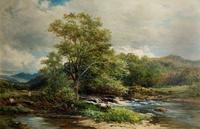
The Banks of the Brathay, Ambleside, Westmoreland
David Bates
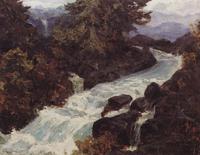
Waterfall
Vasily Polenov
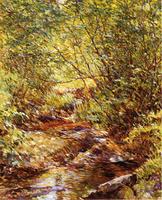
A Woodland Stream
Robert Lewis Reid
Forest Landscape with River
Josef Langl
Landscape with a Waterfall near Norwich, Norfolk
John Crome