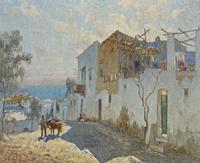
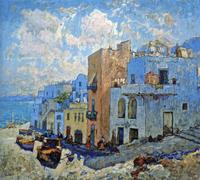
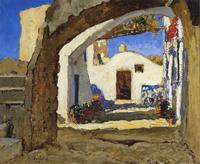
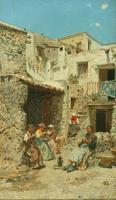
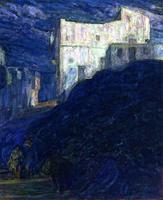
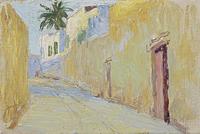
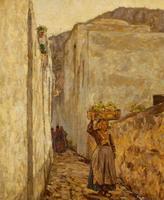
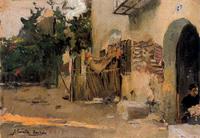
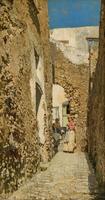
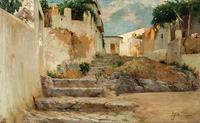
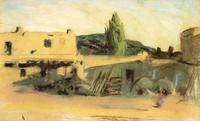
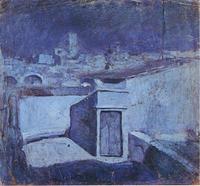
"Na Ilha de Capri" by António de Carvalho da Silva Porto
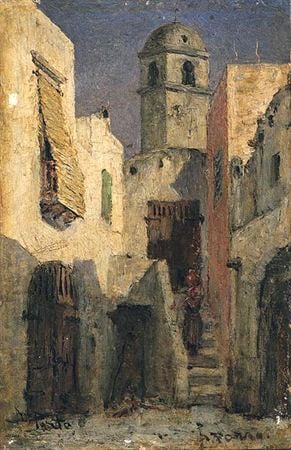
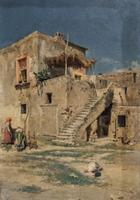
As an Impressionist cityscape, this work is significant for its role in bridging the plein-air innovations of French Impressionism with Portuguese naturalism. Silva Porto, a key figure in the Portuguese "Grupo do Leão," studied in Paris and was deeply influenced by the Barbizon school and early Impressionist masters. In "Na Ilha de Capri" (On the Island of Capri), he applies the movement’s core principles—loose, visible brushwork and a focus on transient light—to a Mediterranean coastal scene.
The cityscape genre is transformed here: rather than a bustling urban center, Silva Porto captures the sun-drenched architecture and rocky shoreline of Capri, a locale celebrated for its luminous atmosphere. The painting’s significance lies in its synthesis: it introduces Impressionism’s chromatic vibrancy and atmospheric precision to a Portuguese context, while also celebrating a quintessentially Italian site. This work exemplifies how Silva Porto and his contemporaries adapted Impressionist techniques to represent the specific light and landscape of southern Europe, making it a landmark in the development of Portuguese modernism.