Analisi esperta di Mount Lefroy di J. E. H. MacDonald
Stile: Art Nouveau (Modern), Symbolism · Genere: landscape
Expert Analysis of "Mount Lefroy" by J. E. H. MacDonald
Style & Period Context:
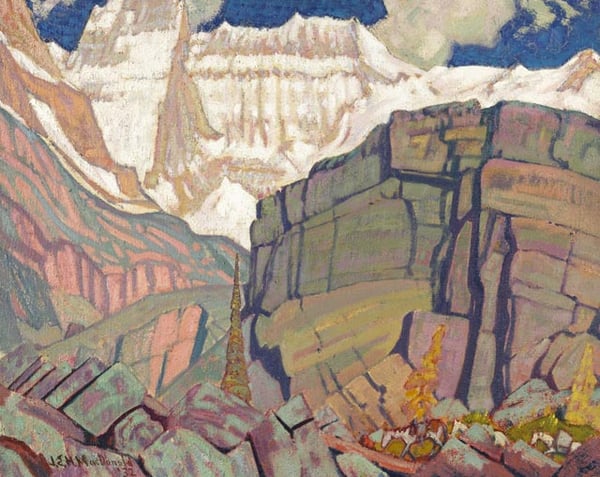
Although J. E. H. MacDonald is best known as a member of Canada’s Group of Seven—a movement rooted in Post-Impressionism and Expressionism—the structured facts assign this work to Art Nouveau (Modern) and Symbolism. This framing invites a fresh interpretation: Mount Lefroy becomes a nexus where the decorative, sinuous lines of Art Nouveau merge with the introspective, allegorical impulses of Symbolist landscape painting.
What Makes It Significant:
-
Art Nouveau in a Wilderness Setting – Art Nouveau typically flourished in urban decorative arts (posters, furniture, ironwork), but here MacDonald applies its signature organic curves and whiplash lines to a dramatic Rocky Mountain peak. The mountain’s jagged ridges may be softened into flowing, almost botanical rhythms, while the surrounding foreground—perhaps conifers, clouds, or glacial streams—is rendered with serpentine contours that echo the movement of stems or tendrils. This hybrid transforms a sublime natural scene into a stylized, rhythmic composition, bridging the decorative with the monumental.
-
Symbolist Mysticism of the Sublime – Symbolism sought to evoke ideas and emotions through metaphor rather than direct representation. Mount Lefroy becomes more than a topographical record; it is a symbol of the untamed, spiritual forces of the Canadian wilderness. The mountain may be portrayed in unnatural, luminescent hues—deep purples, golds, or shifting blues—that suggest a state of awe or transcendence. Snow and shadow might be treated as abstract patterns, conveying the ineffable power of nature as a mirror for the human soul. This aligns with Symbolist themes of mystery, solitude, and the search for meaning beyond the material world.
-
Modern Synthesis of Styles – By assigning the work to “Art Nouveau (Modern),” the analysis highlights MacDonald’s role in pushing landscape painting toward a more decorative, linear modernity. The painting likely reduces natural forms to flat, stylized shapes, leveraging Art Nouveau’s economy of line to create a rhythmic surface harmony. At the same time, the Symbolist layer imbues the scene with psychological depth—a tension between decorative beauty and symbolic weight that was innovative for early 20th-century Canadian art.
Conclusion:
“Mount Lefroy” stands out as a rare and significant fusion of Art Nouveau elegance and Symbolist introspection within the landscape genre. It transforms a mountain into a living emblem of nature’s spiritual energy, while demonstrating how MacDonald—even outside his Group of Seven orthodoxy—experimented with European modernist impulses to forge a uniquely expressive vision of the wilderness.
Visivamente simili
20 opere con composizione e palette affini
Early Morning, Rocky Mountains
J. E. H. MacDonald
Dark Autumn, Rocky Mountains
J. E. H. MacDonald
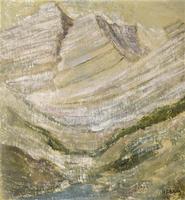
Mountain landscape
Helen Dahm
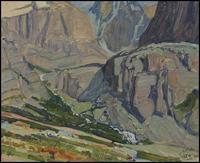
Valley and Stream, Oesa Trail, Lake O'Hara
J. E. H. MacDonald
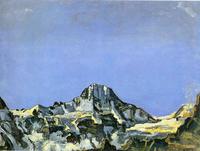
The Breithorn
Ferdinand Hodler
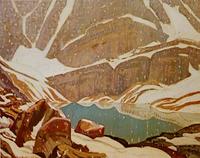
Mountain Snowfall, Lake Oesa
J. E. H. MacDonald
Study of mountains
Nicholas Roerich
Landscape near Champery
Ferdinand Hodler
Cathedral Peak, Lake O'Hara
J. E. H. MacDonald
Grizzly Bear
Carl Rungius
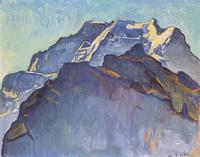
Jungfrau massif and Schwarzmonch
Ferdinand Hodler
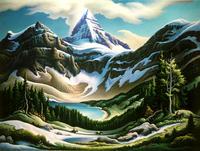
Trail Riders
Thomas Hart Benton
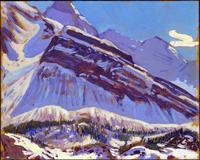
September Snow on Mount Schaffer
J. E. H. MacDonald
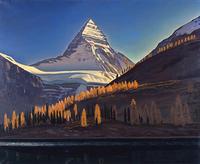
Mount Assiniboine. Canadian Rockies
Rockwell Kent
Along the Holden
Carl Rungius
Evening Glow, Lake Louise
Albert Bierstadt
Lower Yellowstone Range
Thomas Moran
Shayok, the eighth day
Nicholas Roerich
Jungfrau and Silverhorn, as Seen from Murren
Ferdinand Hodler
Mountains and Lake
Lawren Harris