Expert analysis of J. E. H. MacDonald’s Algoma
Style: Art Nouveau (Modern) · Genre: landscape
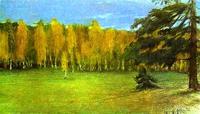
As an art historian, I can provide an expert analysis of "Algoma" by J. E. H. MacDonald based on the supplied facts.
Artwork: Algoma
Artist: J. E. H. MacDonald
Style: Art Nouveau (Modern)
Genre: Landscape
Expert Analysis
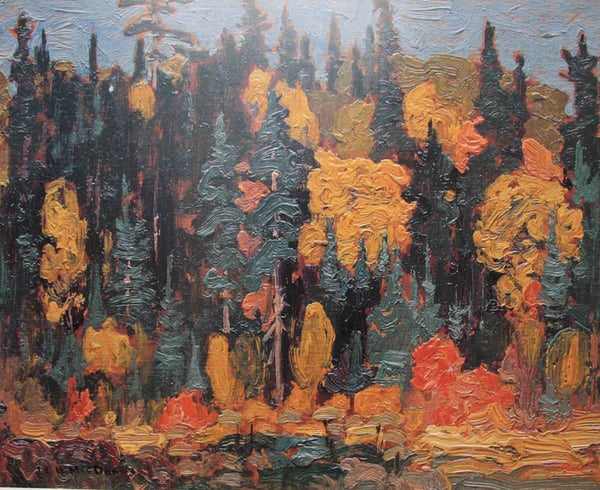
J. E. H. MacDonald’s Algoma is a landmark work that occupies a unique and significant crossroad between the decorative elegance of Art Nouveau and the raw, expressive modernism of early 20th-century landscape painting. While MacDonald is best known as a core member of the Group of Seven—champions of a distinctly Canadian wilderness style—this painting reveals a crucial, often overlooked influence: the sinuous lines, rhythmic patterns, and heightened aestheticism of Art Nouveau.
Significance within Art Nouveau and Modernism:
What makes Algoma exceptional is how MacDonald subverts the typical Art Nouveau subject. Traditionally, Art Nouveau flourished in interior design, poster art, and ornamental objects—not in majestic, untamed landscapes. Here, MacDonald applies Art Nouveau’s signature vocabulary—undulating organic curves, stylized tree forms, and a flattened sense of decorative surface—to the rugged wilderness of northern Ontario. The result is neither purely decorative nor purely naturalistic; it is a synthesis where nature itself becomes a living, breathing pattern.
The painting’s composition is built on a dynamic flow: rolling hills, twisting tree trunks, and winding streams echo the whiplash curves of Art Nouveau masters like Hector Guimard or Alphonse Mucha. Yet the color palette—deep autumnal ochres, russet reds, and emerald greens—is unmistakably drawn from the Canadian Shield, not a Parisian salon. This fusion elevates the landscape from mere topography to a rhythmic, almost musical expression of the land’s vitality.
Modernist Innovation:
By integrating Art Nouveau’s decorative logic with a modernist’s bold, expressive brushwork and simplified forms, MacDonald created a visual language that is both intensely personal and national in scope. Algoma is significant because it demonstrates that Canadian modernism was not simply a derivative of European Post-Impressionism or Fauvism; it was a deliberate, syncretic movement that absorbed and transformed earlier styles to capture a new sense of place.
In this work, the landscape is not a passive background but an active, organic force—a key tenet of the Group of Seven’s philosophy. The sinuous lines of Art Nouveau become the veins of the earth, suggesting a spiritual unity between the artist and the land. This early modernist example predates the Group of Seven’s fully realized style, marking Algoma as a crucial transitional piece—one where the ornamental beauty of Art Nouveau meets the bold simplicity of modern painting, ultimately forging a iconic Canadian aesthetic.
Genre
Style
Visually similar
20 works with related composition and palette
Woods, Algoma
Lawren Harris
Autumn on the River
Konstantin Gorbatov
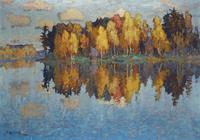
Autumn Day
Konstantin Gorbatov
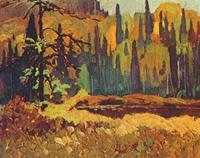
Moose Pond
Frank Johnston
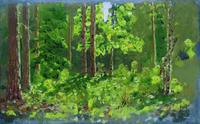
Forest
Arkhyp Kuindzhi
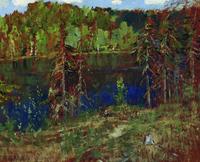
Lake in the forest
Isaac Levitan

Autumn forest
Endre Bartos
Yellowstone Silhouette
Wolf Kahn
Young Canada
J. E. H. MacDonald
First snow
Veniamin Kremer
Full Moon & Silence
Karl Schrag
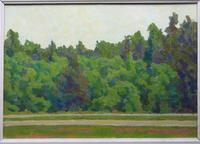
Landscape
Hryhorii Havrylenko
Landscape with Evening Sky
Louis Comfort Tiffany
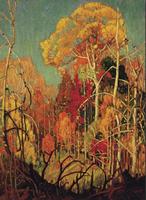
Autumn in Orillia
Franklin Carmichael
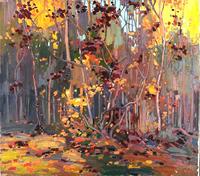
Maple Saplings
Tom Thomson
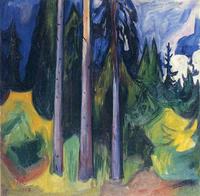
Forest
Edvard Munch
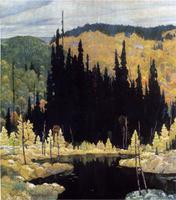
Autumn, Algoma
Frank Johnston
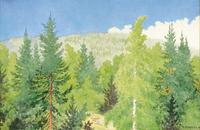
Forest - Skog
Theodor Severin Kittelsen
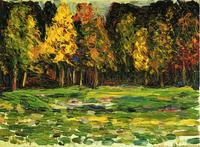
Forest edge
Wassily Kandinsky
Autumn Landscape
Isaac Levitan