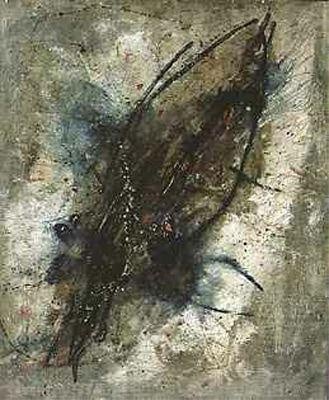
Wols の Aile de Papillon の専門的な分析
スタイル:Tachisme · ジャンル:abstract
Expert Analysis of "Aile de Papillon" by Wols
Style Context (Tachisme):
Tachisme—from the French tache (stain or blotch)—emerged in post-World War II Europe as a radical departure from geometric abstraction. It prioritized spontaneity, automatism, and the raw physicality of paint application, often through drips, splatters, and uncontrolled gestures. This movement sought to channel the subconscious directly onto the canvas, aligning with existentialist notions of individual freedom and the absurdity of existence.
Significance of "Aile de Papillon":
Wols (Alfred Otto Wolfgang Schulze) is a pivotal figure in Tachisme, and Aile de Papillon (meaning "Butterfly Wing") exemplifies the movement's core principles. The title itself evokes fragile, organic forms—mirroring the delicate, ephemeral qualities that Wols achieved through his technique. Rather than representing an actual butterfly wing, the painting captures the sensation of flight, lightness, and transient beauty through amorphous stains and ghostly trails of pigment.
What makes this work significant within Tachisme is its integration of lyrical abstraction with a deep sense of materiality. Wols often worked on paper or thin canvas, allowing paint to soak and bleed, creating veils of color that seem to hover between presence and absence. In Aile de Papillon, the irregular patches and pale translucencies resist fixed interpretation, inviting the viewer into a state of contemplation. The painting’s gestural freedom—where the artist’s hand seemed guided by impulse rather than premeditation—embodies the Tachiste rejection of rational composition. Instead of a calculated structure, the composition emerges from accidental interactions of paint, water, and surface.
Historical Role:
Wols stands as a precursor to later European Art Informel and American Abstract Expressionism. Aile de Papillon demonstrates how Tachisme bridged Surrealist automatism with a post-war existential urgency. The work’s title-and-form tension—a specific, delicate image (butterfly wing) rendered through chaotic, non-representational means—underscores the movement’s philosophical stance: meaning is not imposed but discovered in the act of looking. This piece remains a touchstone for understanding how Tachiste artists transformed stain and accident into a vocabulary of emotional immediacy.
視覚的に類似
構図やパレットが近い作品 20 件
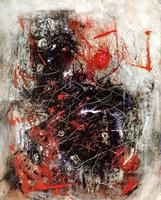
Oui, Oui, Oui
Wols
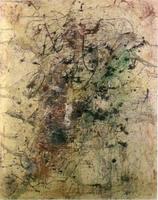
Le Grand Orgasme
Wols
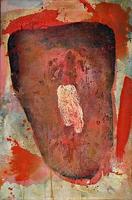
Untitled
Shozo Shimamoto
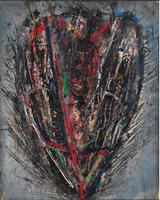
La flamme
Wols
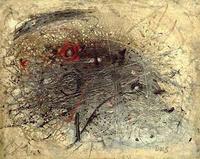
Untitled 6
Wols
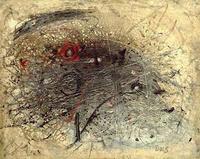
Untitled
Wols
Oui, oui, oui
Wols
Concept Spatiale
Lucio Fontana
Untitled
Wols
Untitled
Claude Georges
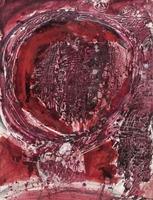
Red composition
Horia Damian
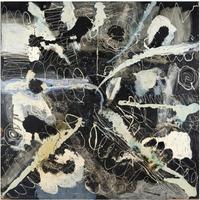
Work-K-61
Matsutani
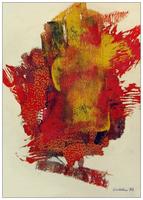
Untitled
Luciano Bartolini
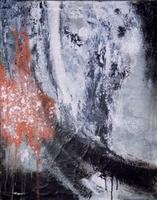
Untitled
Jiro Yoshihara
Untitled (Komposition 40)
Modest Cuixart
Graffiti- matèries
Modest Cuixart
Untitled
Afro
A Native's Right
Dan Goorevitch
GE-11
Emil Schumacher
Ras de Tramort
Modest Cuixart