Wols sanatçısının Don Juan eseri hakkında uzman analizi
Tarz: Art Informel · Tür: abstract
Expert Analysis of "Don Juan" by Wols
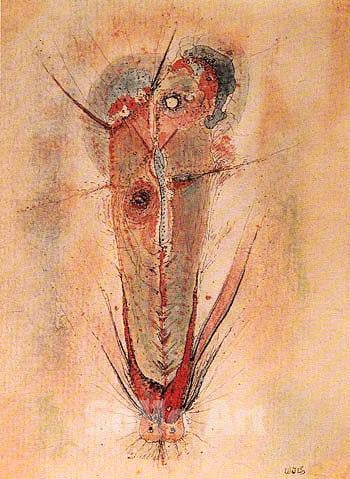
Wols’ "Don Juan" stands as a seminal work within the Art Informel movement—a radical departure from geometric abstraction that emerged in post-war Europe. Created in a period marked by existential uncertainty and a desire to break from tradition, this piece embodies the movement’s core principles: spontaneity, gestural freedom, and a raw, subconscious expression.
Significance within Art Informel:
-
Pioneering Automatic Mark-Making: Wols, a key forerunner of Art Informel, abandoned premeditated composition in favor of automatic techniques. In "Don Juan", the surface is a labyrinth of delicate, interwoven lines—some scratching into the paint, others flowing with watery washes. This method, derived from Surrealist automatism, allows the unconscious to guide the hand, creating a sense of immediate, unpremeditated energy.
-
Rejection of Formal Structure: Unlike abstract geometric art that sought order and rationality, "Don Juan" exemplifies Art Informel’s antiformalism. There is no central focal point, symmetry, or clear spatial hierarchy. Instead, the viewer is immersed in a chaotic yet intricate web of marks that seem to expand beyond the canvas edge, evoking a sense of infinite, organic growth.
-
Biomorphic Allusion and Symbolism: The title "Don Juan"—referencing the legendary seducer—suggests themes of desire, transgression, and archetypal passion. However, Wols abstracts these concepts into biomorphic forms: swirling, embryonic shapes that hover between figuration and dissolution. The lines appear both delicate and violent, like the traces of a fevered hand, capturing the psychological tension of the human condition in the aftermath of war.
-
Influence on Tachisme and Lyrical Abstraction: With its emphasis on "tache" (stain) and calligraphic gesture, "Don Juan" prefigures the later Tachiste movement. Wols’ technique of allowing paint to drip, pool, and scratch into the canvas—rather than being applied deliberately—makes this work a blueprint for lyrical abstraction, where the act of painting itself becomes the subject.
Conclusion:
"Don Juan" is not merely an abstract composition; it is a psychological landscape where the artist’s hand and subconscious collide. By prioritizing raw gesture over representation, Wols helped define Art Informel as a movement that voiced the existential angst and creative liberation of its time. This work remains a testament to the power of unmediated expression, influencing generations of European abstract artists who sought to render the invisible—emotion, memory, the unconscious—in visible, tangible form.
Tür
Stil
Görsel olarak benzer
İlişkili kompozisyon ve renk paletine sahip 20 eser
Composition aux trois têtes
Henri Michaux
Drawing for Etching II
Wassily Kandinsky
Untitled
Mark Rothko
Untitled
Wols
Untitled
Zdzislaw Beksinski
The Genius of the Species
Andre Masson
Untitled
Zdzislaw Beksinski
Planta tuberosa
Wols
Untitled
Grace Pailthorpe
Demi Pirouette (Half Turn on the Haunches)
Jo Baer
Dauka 12
Małgorzata Serwatka
Invaders 15×21cm Ink ×paper 2022
Thomas Riesner
Untitled
Vasile Kazar
Forêt convulsive
Theo Gerber
Attacked by birds
Andre Masson
Flight of the Spectre
Theodoros Stamos
Maldoror
Mario Cesariny
Untitled
Anna Zemánková
Dread 2 15×21cm Ink ×paper 2022
Thomas Riesner
Baum-Wesen
Leiko Ikemura