Expert analysis of Filipp Malyavin’s Verka
Style: Art Nouveau (Modern) · Genre: portrait
Expert Art Historical Analysis of Verka by Filipp Malyavin
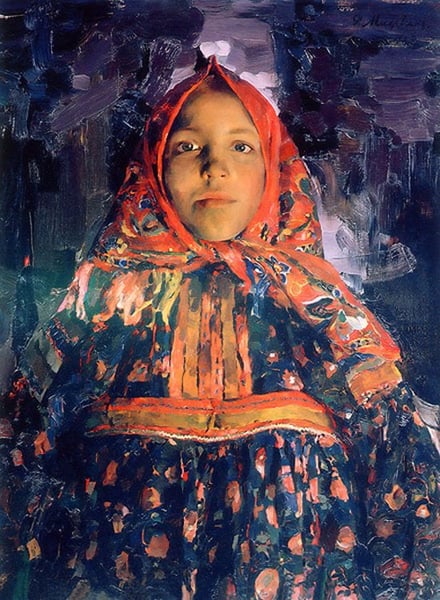
Filipp Malyavin’s Verka stands as a compelling example of Russian Art Nouveau, merging the movement’s decorative elegance with a raw, expressive vitality that is distinctly Malyavin’s own. Painted in the genre of portraiture, the work transcends mere likeness to become a celebration of folk identity and modernist visual language.
Significance within Art Nouveau and Modernism:
While many Art Nouveau artists favored sinuous, floral motifs and ethereal, urban subjects, Malyavin rooted his modernism in the Russian countryside. Verka exemplifies this through its bold, almost Fauvist palette—dominated by fiery reds and earthy tones—that pulses with life. The subject, presumably a peasant woman, is rendered not with delicate, decorative linework but with thick, swirling brushstrokes that animate her shawl and clothing, creating a rhythmic, almost musical surface. These vigorous marks recall the decorative swirls of Art Nouveau yet carry an aggressive expressiveness that pushes toward Expressionism.
What Makes Verka Significant:
- Fusion of Folk and Modern: Malyavin captured the spirit of rural Russia using the flatness and surface dynamism of modern art. The figure’s expansive, monumental pose breaks with academic portraiture; her wide, staring eyes and flushed cheeks convey not individual psychology but a collective, elemental energy—a hallmark of Malyavin’s peasant portraits.
- Color as Emotion: The intense reds and oranges, applied in dense impasto, are a signature of Malyavin’s work. In Verka, color becomes the primary vehicle for mood—exuberant, defiant, and unapologetically raw. This aligns with Art Nouveau’s interest in symbolic color, but Malyavin’s hues are less decorative than explosive.
- Brushwork and Surface: The thick, visible strokes create a tactile, shimmering surface that draws the viewer into the fabric of the painting. This emphasis on materiality—the paint itself as an expressive medium—places Verka within the broader modernist turn away from illusionism toward self-conscious artistry.
Conclusion:
Verka is significant not only as a portrait of a specific individual but as a manifesto of Malyavin’s revolutionary approach to Russian modernism. It challenges the refined, often precious aesthetic of Western Art Nouveau with a robust, democratic vitality, proving that the movement could embrace folk authenticity without sacrificing formal innovation. In this work, Malyavin captures the fierce soul of a people on the cusp of modernity—a timeless, burning image that still ignites the eye today.
Visually similar
20 works with related composition and palette
Little girl with yellow babushka
Istvan Nagy
Girl in a Kerchief (Portrait of the Girl)
Konstantin Makovsky
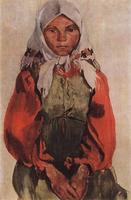
Country Girl
Zinaida Serebriakova
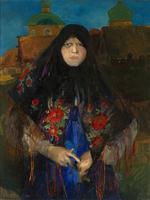
Portrait of a rich peasant
Filipp Malyavin
The Little Girl with Red Headscarf
Nicolae Grigorescu
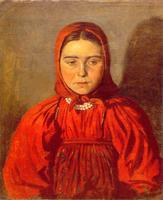
The girl in red
Nikolai Kuznetsov
Country Boy
Nikolay Bogdanov-Belsky
A girl with scarf
Ivan Tvorozhnikov
Portrait of the Girl
Konstantin Makovsky
A Pequena Aldeã
Lasar Segall
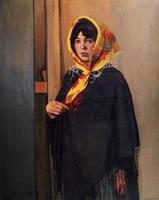
Young Woman with Yellow Scarf
Felix Vallotton
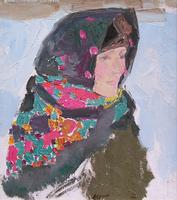
Portrait of a Woman in a Kerchief
Alla Horska
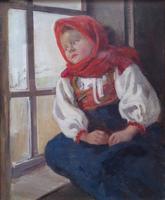
Slovak girl
Dobri Dobrev
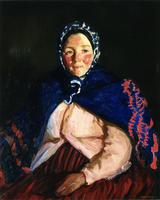
Old Johnnie's Wife
Robert Henri
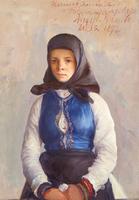
Ferenczy Károly, Fejkendős Lány 1898
Karoly Ferenczy
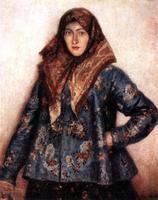
Portrait of L. T. Matorina. Cossack woman.
Vasily Surikov
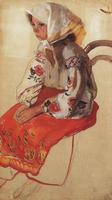
Peasant Girl
Zinaida Serebriakova
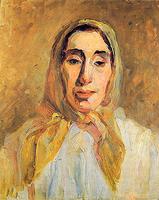
Camponesa Espanhola
Tarsila do Amaral
Female Portrait
Viktor Shatalin
Russian Beauty
Alexander Shilov