Dmitry Levitzky sanatçısının Portrait of Procope Demidov eseri hakkında uzman analizi
Tarz: Rococo · Tür: portrait
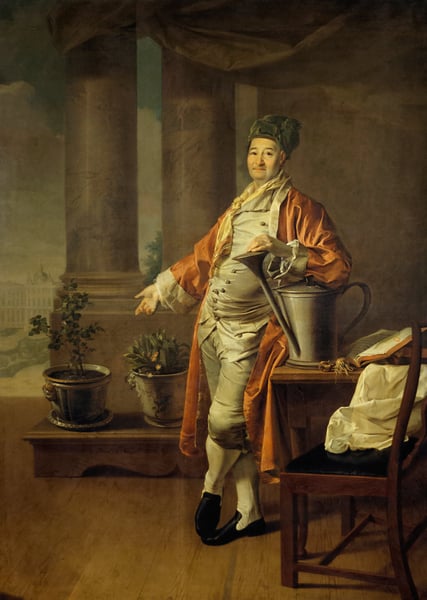
Expert Analysis: "Portrait of Procope Demidov" by Dmitry Levitzky
This portrait exemplifies the Rococo style's emphasis on refined elegance, ornate detail, and delicate interplay of light and color, while also serving as a striking document of 18th-century Russian aristocracy. Painted by Dmitry Levitzky, one of the foremost Russian portraitists of the era, the work bridges Western European Rococo aesthetics with the distinct identity of the Russian elite.
Significance within the Rococo Style and Period:
Levitzky masterfully employs the Rococo palette of soft, pastel hues—gently modulated whites, pale blues, and muted golds—to render his subject with an air of ease and sophistication. The composition's graceful, slightly asymmetrical pose and the sumptuous textures of fabric (silks, lace, and velvet) are hallmarks of Rococo portraiture, which prized visual charm and decorative surface beauty over Baroque monumentality.
Yet the painting's deeper significance lies in its fusion of Rococo elegance with Enlightenment-era portraiture. Procope Demidov, a renowned Russian industrialist, plant collector, and philanthropist, is depicted not merely as a nobleman but as a man of learning and taste. In his hand, he holds a botanical specimen—a direct reference to his renowned collection of rare plants (the Demidov Botanical Garden in Moscow). This inclusion of scientific interest aligns with the Rococo period's fascination with natural history and the decorative arts, while also elevating the portrait from a simple likeness into a statement of intellectual and cultural status.
Levitzky's handling of light and shadow softens Demidov's features, lending him a gently introspective expression, which contrasts with the more formal, stiff poses of earlier Russian portraiture. This psychological nuance—characteristic of Rococo's move toward intimacy—combined with the exquisite rendering of lace, fur, and botanical detail, makes the work a pinnacle of late 18th-century Russian Rococo. It stands as a testament to how the style was adapted by Russian artists to convey both material wealth and enlightened sensibility, securing Levitzky's reputation as a master of the era.
Museum / Gallery
Görsel olarak benzer
İlişkili kompozisyon ve renk paletine sahip 20 eser
John Postlethwaite
George Romney
Elkanah Watson
John Singleton Copley
Peter du Cane (1741–1823)
Anton von Maron
Nathaniel Sparhawk
John Singleton Copley
Portrait of John Talbot, Later 1st Earl Talbot
Pompeo Batoni
Portrait of Thomas Estcourt, Esquire
Pompeo Batoni
Moses Gill
John Singleton Copley
Reverend Daniel Wilson
George Romney
Edward Shuter, John Beard, and John Dunstall in Isaac Bickerton's ‘Love in a Village’
Johann Zoffany
Portrait of Lionel Damer
Pompeo Batoni
Victor Riquetti (1715-89), Marquis of Mirabeau
Jacques Aved
Joseph-Marie Vien
Joseph Duplessis
A portrait of John Morgan
Angelica Kauffman
Charles Jenkinson, 1st Earl of Liverpool
George Romney
Charles Jenkinson (1727–1808), 1st Lord Hawkesbury (1780), afterwards Created 1st Earl of Liverpool (1796)
George Romney
Charles-Claude Flahaut De La Billaderie
Joseph Duplessis
Sir Gregory Page-Turner
Pompeo Batoni
Portrait of Sir Thomas Gascoigne, 8th Baronet
Pompeo Batoni
James Caulfeild, Fourth Viscount Charlemont (later First Earl of Charlemont)
Pompeo Batoni
Charles Wesley (1757–1834)
John Russell