Expertenanalyse zu Paula Modersohn-Beckers Seated Peasant Woman
Stil: Expressionism · Genre: sketch and study
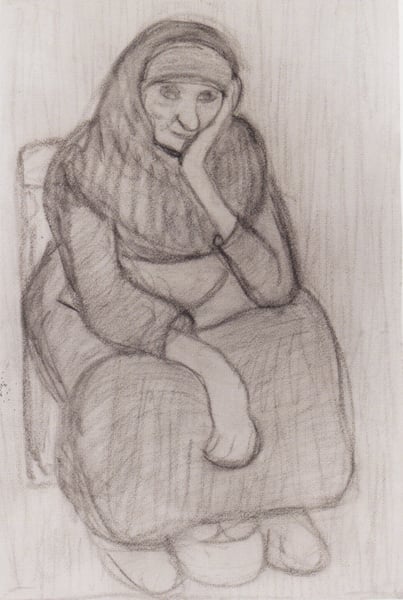
The sketch Seated Peasant Woman by Paula Modersohn-Becker is a quiet but powerful testament to the artist’s revolutionary contribution to early Expressionism. As a sketch and study, it offers a privileged glimpse into her working method—a raw, unpolished moment of observation that captures the monumental dignity she conferred upon her subjects.
Significance within Expressionism and Her Oeuvre
Modersohn-Becker was a pivotal bridge between Post-Impressionism and German Expressionism, and this study exemplifies her distinctive approach. Unlike the more theatrical or angst-ridden works of later Expressionists (e.g., Kirchner or Nolde), her sketches reveal a grounded, empathetic humanism. The “Seated Peasant Woman” is not an exoticized peasant type but a specific, solid presence. The artist’s quick, searching lines and simplified volumes—likely drawn in charcoal or chalk—echo the influence of Paul Cézanne’s geometric structuring of form, yet they are infused with a personal, almost tactile immediacy.
This work is significant for several reasons:
-
The Elevation of the Sketch: In Modersohn-Becker’s hands, a study is not a mere preparatory step but a finished artistic statement. The raw energy of the line—the way it defines the woman’s hunched shoulders, heavy hands, and grounded pose—conveys the weight of labor and the stillness of contemplation. This aligns with the Expressionist goal of transmitting inner feeling over surface realism.
-
Early Feminist Gaze: As one of the first women artists to paint the female body from a non-objectifying perspective, Modersohn-Becker found in peasant women a symbol of primal strength and endurance. Seated Peasant Woman is devoid of sentimentality; the subject is presented as a sovereign being, her posture echoing that of a classical mother goddess, yet rooted in the earth of Worpswede. This study foreshadows her later, more radical nudes and portraits.
-
Simplification as Power: The sketch demonstrates her move toward essential forms—a hallmark of her mature style just before her untimely death in 1907. The face may be only hinted at, the clothing rendered in broad strokes, but the overall silhouette is monumental. This simplification, inspired by Gauguin’s cloisonnism and primitive art, would directly influence the Brücke group and subsequent Expressionist woodcuts.
In sum, Seated Peasant Woman is significant not for its finish, but for its concentrated expressive force. It captures a moment where Modersohn-Becker transforms a simple study into an icon of human presence—a quiet, radical assertion of the dignity of the common woman in an age of rapid industrialization. This work is a key precursor to the emotional intensity that would define German Expressionism.
Visuell ähnlich
20 Werke mit ähnlicher Komposition und Farbpalette
Woman with a Mourning Shawl
Vincent van Gogh
Bortnyik Sándor, Fejkendős Paraszt Asszony
Sandor Bortnyik
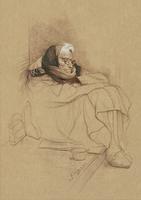
Needy Woman in Cold
Morteza Katouzian
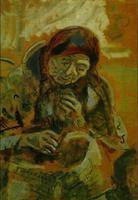
Old Woman with a Ball of Yarn
Marc Chagall
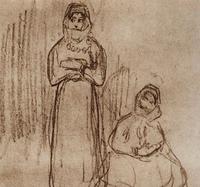
Peasants
Martiros Sarian
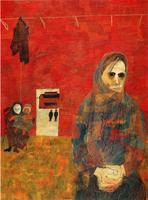
Miner's Wives
Ben Shahn
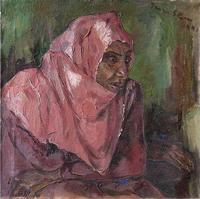
Portrait of a Woman Wearing a Pink Hijab
Irma Stern
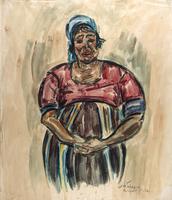
Arab Woman, Kairouan
William H. Johnson
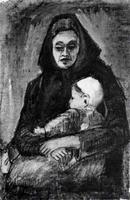
Woman with Baby on her Lap, Half-Length
Vincent van Gogh
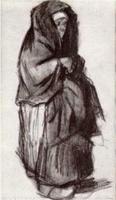
Peasant Woman with Shawl over her Head, Seen from the Side
Vincent van Gogh
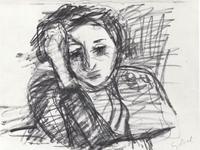
Head of Women
Bela Czobel
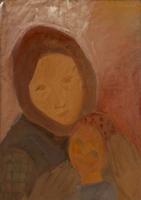
Modok Mária, Anyaság
Modok Mária
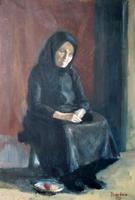
Aged Hungarian peasant woman
Endre Bartos
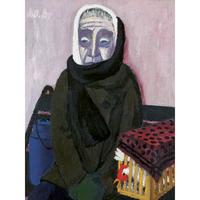
Woman Waiting on Her Way to the Market
Werner Berg
The victim of genocide
Mariam Aslamazian
The artist's mother
Chronis Botsoglou
Girl in Interior
Bela Czobel
Mother's Portrait
Minas Avetisyan
Sonja krohn
Sonja Krohn
Inconsolable grief
Mariam Aslamazian