Analisi esperta di The Fourth Ode (From The Prize Poem Series) di Ali Omar Ermes
Stile: Lyrical Abstraction · Genere: abstract
Expert Analysis of "The Fourth Ode (From The Prize Poem Series)" by Ali Omar Ermes
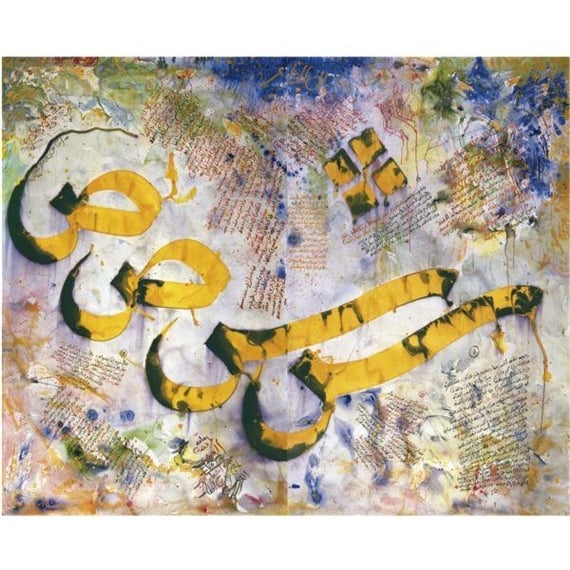
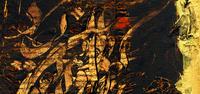
Ali Omar Ermes’s The Fourth Ode is a compelling example of Lyrical Abstraction, a post-war movement that prioritizes personal, spontaneous expression and often evokes the rhythms of music or poetry. Within this style, Ermes achieves a distinctive synthesis that makes the work significant: he bridges the gestural freedom of Western abstract expressionism with the disciplined, sacred traditions of Arabic calligraphy.
The title itself signals the work’s conceptual foundation. By naming the piece “The Fourth Ode” and placing it within a “Prize Poem Series,” Ermes directly ties his visual language to the structure and emotional cadence of classical Arabic poetry. In Lyrical Abstraction, artists often seek to translate musical or poetic sensations into color and form; Ermes deepens this by embedding the actual script—or its abstracted essence—as the primary compositional force. The “ode” (qasida) is a revered form in Arabic literature, and Ermes treats the canvas as a manuscript reimagined, where the marks do not simply illustrate a poem but become the poem’s visual breath.
Stylistically, the work exhibits the hallmarks of Lyrical Abstraction: fluid, energetic brushwork, a sense of spontaneity, and a dynamic interplay of positive and negative space. However, Ermes’s abstraction is rooted in the morphology of Arabic letters—their curves, dots, and vertical ascents. Unlike pure calligraphy, where legibility is paramount, Ermes dissolves or subtracts parts of the letters, allowing their shapes to float, overlap, and pulse like notes in a musical score. This creates a liminal space between meaning and pure aesthetic gesture, inviting the viewer to “read” the emotion rather than the word.
What makes The Fourth Ode significant within Lyrical Abstraction is its cultural and spiritual layering. While many Western lyrical abstraccionists drew from jazz or nature, Ermes channels a heritage of Islamic ornamentation and Qur’anic illumination. The palette—often earthy or jewel-toned—and the balanced asymmetry recall traditional Arabic manuscript margins, yet the execution is radically modern, loose, and non-representational. This fusion challenges the notion that abstraction is exclusively a Western invention, asserting instead that Islamic visual culture has always possessed an abstract, non-figurative dimension.
In the broader context of modern art, Ermes’s series exemplifies how Lyrical Abstraction can serve as a platform for cross-cultural dialogue. The Fourth Ode is not merely a formal exercise; it is a meditative act that transforms the written word into a living, breathing mark—a celebration of language as a source of visual poetry. For viewers, the work’s significance lies in its ability to evoke a mystical, almost calligraphic murmur without resorting to literal narration. It stands as a testament to how abstraction can carry the weight of tradition while remaining deeply personal, lyrical, and transcendent.
Visivamente simili
20 opere con composizione e palette affini
Meem, Tha, Alif: Turaath (Heritage)
Ali Omar Ermes
Tughriyat Ebni Zuhair
Ali Omar Ermes
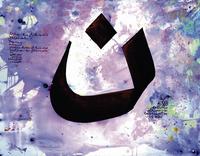
The Sharp and Competent
Ali Omar Ermes
Chant in Paradise
Esmaeil Rezaei
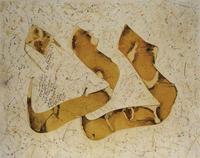
Dal Dhal
Ali Omar Ermes
www.esmaeilrezaei.ir
Esmaeil Rezaei
Name of God
Esmaeil Rezaei
Heaven Of PARADISE
Esmaeil Rezaei
Leily more insane
Esmaeil Rezaei
Contradictions of Joy
Ali Omar Ermes
Untitled
Hassan Massoudy
Woman is a ray of divine light
Hassan Massoudy
Form of Paradise
Esmaeil Rezaei
you are My mine
Esmaeil Rezaei
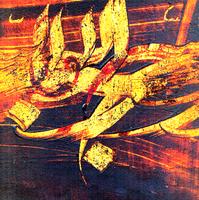
In The Name Of God
Esmaeil Rezaei
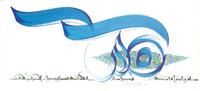
Travel if you aim for certain values. By travelling the skies, the crescent becommes a full moon
Hassan Massoudy
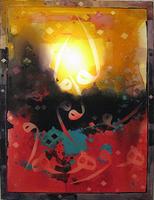
Calligraphy
Abdul Qader Al Raes
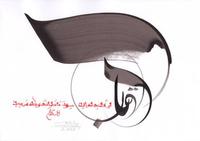
My heart has eyes that see only for you, and it is completely in your hands (Al Hallaj)
Hassan Massoudy
Almost everyone
Esmaeil Rezaei
First Name
Hossein Zenderoudi