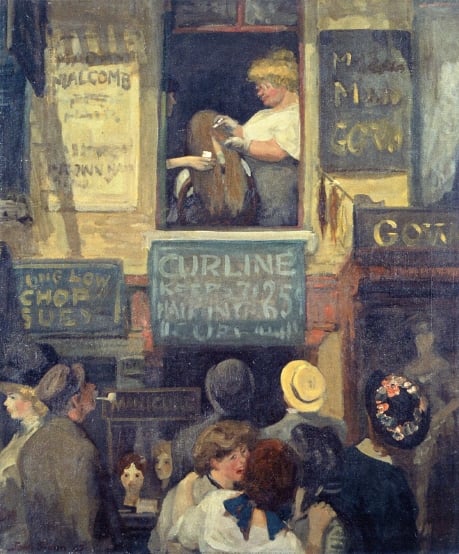
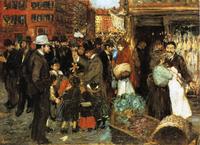
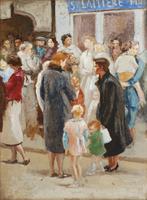
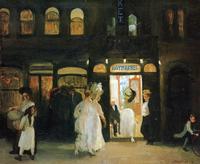
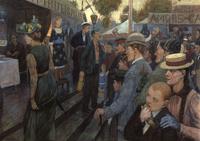
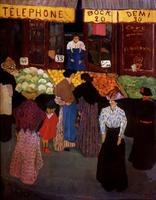
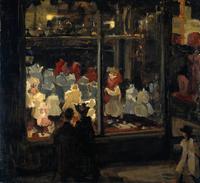
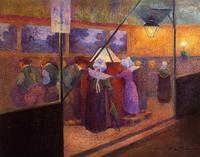
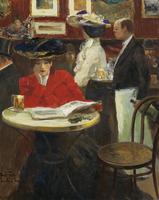
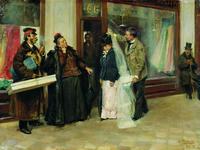
John French Sloan’s Hairdresser’s Window (1907) is a quintessential example of the New Realism—often called the Ashcan School—that emerged in early twentieth-century America. This genre painting captures a seemingly mundane urban moment, yet it reveals Sloan’s radical commitment to depicting everyday life with unvarnished honesty. The significance lies in how the composition transforms a simple storefront vignette into a layered social document. Instead of idealizing the city, Sloan focuses on a working-class hairdresser’s shop, using the window display as both a physical and symbolic barrier between the public street and private labor. The arrangement—a woman washing a customer’s hair, a child peering in, and a clerk at the counter—feels spontaneous, as if the painter caught a fleeting exchange. Sloan’s loose, expressive brushwork and muted palette heighten the sense of ordinary, non-heroic existence. This work challenges the prevailing academic preference for grand historical or allegorical scenes, asserting that anonymous urban lives are worthy of artistic attention. It also exemplifies the New Realist interest in the psychology of space: the window functions as a stage, turning passersby into accidental participants. By elevating a hairdresser’s labor to the level of serious art, Sloan helped redefine American realism, making Hairdresser’s Window a landmark in the shift toward a more democratic, observational modernism.