Expert Analysis of "Sun and Wind on the Roof" by John French Sloan
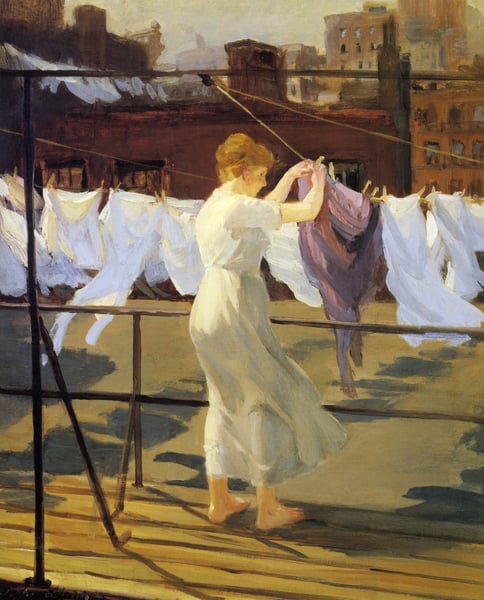
This work is a quintessential example of the New Realism movement, which emerged in early 20th-century America as a direct response to academic art and Impressionism’s genteel subjects. As a genre painting, it elevates a seemingly ordinary moment—figures on a tenement roof, bathed in natural elements—into a powerful commentary on urban life.
The painting’s significance lies in its unflinching embrace of everyday reality. Sloan strips away romanticism, presenting the roof not as a picturesque escape but as a functional, often gritty, social space. The title itself foregrounds the interplay of sun and wind, signaling a rigorous attention to atmospheric effects that ground the scene in a specific, palpable moment. By focusing on working-class individuals in a humble setting, Sloan asserts that truth and beauty can be found in the overlooked corners of the modern city. This work embodies the New Realist credo: art should document life as it is, not as it is idealized. “Sun and Wind on the Roof” remains significant for its democratic subject matter and its fusion of naturalistic observation with a robust, candid portrayal of early 20th-century America.