
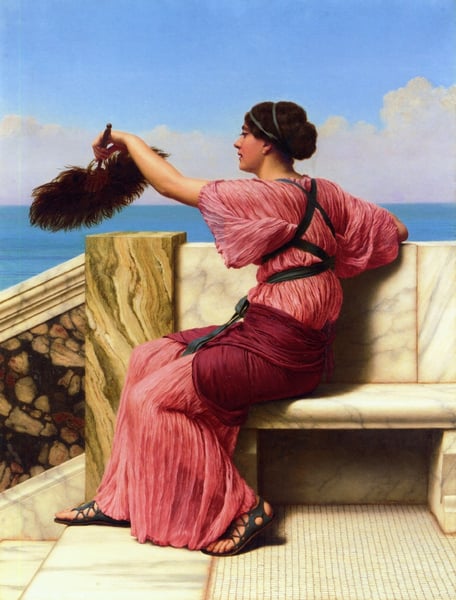
Expert analysis of John William Godward’s The Signal
Style: Neoclassicism · Genre: genre painting
Expert Analysis: "The Signal" by John William Godward
John William Godward’s The Signal (c. 1899) stands as a quintessential example of late Victorian Neoclassicism, a style that sought to revive the idealized beauty and architectural precision of ancient Greco-Roman life. While Godward is often overshadowed by his more famous contemporary Sir Lawrence Alma-Tadema, his work in this genre painting is significant for its meticulous craftsmanship, serene yet charged emotional atmosphere, and its role as a late flowering of academic classicism at a time when avant-garde movements like Post-Impressionism were gaining ground.
Composition and Visual Language
The painting depicts a solitary young woman seated on a marble balustrade overlooking a brilliant blue Mediterranean Sea. She holds a vibrant orange shawl or scarf, which cascades down her arm—the titular “signal” suggesting a narrative of waiting, longing, or clandestine communication. Godward’s composition is deliberately balanced and serene: the vertical lines of the fluted marble columns contrast with the horizontal expanse of the sea and sky, while the figure’s curved posture creates a gentle diagonal that guides the eye from the viewer toward the distant horizon.
Significance in Style and Period
-
Mastery of Marble and Texture: Godward was celebrated—and occasionally criticized—for his obsessive attention to the tactile qualities of stone. In The Signal, the sunlit marble balustrade appears almost photographically real, with subtle variations of warm ochre and cool gray that capture the light of the southern coast. This hyper-realistic rendering of classical architecture was a hallmark of Neoclassicist ambition, elevating a genre scene to near-sculptural permanence.
-
Color as Emotional Conduit: Godward employed a restrained but potent palette. The woman’s flowing white stola (classical robe) and the cool marble are punctuated by the signal cloth’s fiery orange. This small, strategic burst of warm color infuses the otherwise calm scene with latent tension—the signal suggests communication, perhaps a lover’s rendezvous or a declaration. The contrast between the static, eternal stone and the fleeting, human gesture makes the painting psychologically compelling.
-
The “Last of the Classicists”: By the 1890s, Neoclassicism was considered outdated by many critics. Godward, however, refused to abandon the discipline of line, proportion, and archaeological accuracy. The Signal thus represents a brave, almost defiant commitment to academic ideals. Its significance lies in how it synthesizes the clarity of Ingres, the archaeological precision of Alma-Tadema, and a distinctly fin-de-siècle sensibility—an idealized past as an escape from industrial modernity.
Narrative and Genre
As a genre painting (a scene of everyday life, albeit in an ancient setting), The Signal invites interpretation. The woman’s gaze is not toward the viewer but outward, toward the unseen receiver of her signal. This off-stage narrative engages the viewer’s imagination: Is she signaling a ship? A lover on the shore? The ambiguity is deliberate, allowing the painting to function both as a decorative vision of classical beauty and as a quiet drama of anticipation.
In summary, The Signal is significant for its technical virtuosity in rendering marble and light, its poignant use of color to suggest emotion within a balanced Neoclassical composition, and its status as a late, masterful expression of a style that was vanishing under the tide of modernism. It captures Godward’s central theme: the eternal human moment frozen within an unchanging classical world.
Museum / Gallery
Visually similar
20 works with related composition and palette

A Fond Farewell
John William Godward

In the Days of Sappho
John William Godward

On the Balcony
John William Godward
The Belvedere
John William Godward

Phyleis
John William Godward

Mischief
John William Godward

Absence Makes the Heart Grow Fonder
John William Godward

A Classical Lady
John William Godward

Idleness
John William Godward

In the Prime of the Summer Time
John William Godward
Leisure Hours
John William Godward
Golden Hours
John William Godward

Tranquillity
John William Godward
Reflections
John William Godward

By the Wayside
John William Godward
Yes or No
John William Godward
The Favourite
John William Godward
A Souvenir
John William Godward

Sweet Dreams
John William Godward

By the Blue Ionian Sea
John William Godward