John William Godward sanatçısının A Pompeian Bath eseri hakkında uzman analizi
Tarz: Neoclassicism · Tür: nude painting (nu)
Analysis of A Pompeian Bath by John William Godward
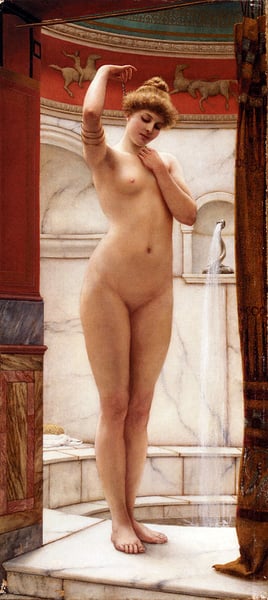
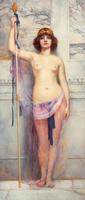
John William Godward (1861–1922) was a British painter who, alongside Sir Lawrence Alma-Tadema, represents the final flowering of Victorian Neoclassicism. His work, synonymous with an almost photographic precision and a yearning for a lost classical world, finds its quintessence in A Pompeian Bath (likely painted in the late 1890s or early 1900s, though the exact date is often debated).
Significance within Neoclassicism
Godward’s Neoclassicism is notable for its intense, almost archaeological focus on the tactile surfaces of the ancient world—marble, terracotta, silk, and the softness of female flesh. Unlike the more narrative-driven history paintings of earlier Neoclassicists (e.g., David’s Oath of the Horatii), Godward’s work is mood-driven. He creates a static, idealized vision of antiquity where the drama is not action but atmosphere. A Pompeian Bath is a pure “genre” scene from this perspective: it does not tell a specific story from history or mythology. Instead, it invites the viewer into a private, sunlit moment of bodily relaxation and aesthetic contemplation.
The Nude as Ideal Form
As a nude painting (nu), the work operates within the centuries-old tradition of the female nude as a vehicle for formal beauty. However, Godward’s approach is distinct from both the sensuality of the Pre-Raphaelites and the bravura of the French academicians. His nudes are often described as “cold” or “marble-like”—not in a pejorative sense, but to highlight his deliberate choice to align skin tone with the surrounding white and rose-veined marbles. The bather’s body is rendered with extreme smoothness, devoid of expressive brushwork. This technique emphasizes the Neoclassical ideal of line over color, and of form as timeless, perfect geometry.
The “Pompeian” Context
The title anchors the scene in the specific archaeological reality of Pompeii—a city that obsessed late Victorian culture. Godward’s careful rendering of the marble basin, the mosaic floor, the bronze vessels, and the classical architecture is a mark of his scholarly rigor. Yet he does not simply copy Roman frescoes; he synthesizes them into a fantasy of hygienic, serene luxury. The figure’s introspective posture—turning away slightly, pouring water or arranging her hair—creates a sense of privileged privacy. We are allowed to gaze, but the subject does not acknowledge us, preserving the illusion of a captured, unscripted moment.
Legacy and Why It Matters
A Pompeian Bath represents the apex of Godward’s mature style, a style that would soon be rendered obsolete by Modernism. Its significance lies in its flawless execution of an ideal: a world without grime or pain, where time stands still in a Mediterranean sunbeam. Art historians value Godward today as a poignant example of late academic art—a painter who, at the dawn of the 20th century, dedicated himself entirely to a classical past that no longer believed in itself. This painting, with its silent marble and serene flesh, is both a magnificent technical achievement and an elegy for a lost aesthetic order.
Museum / Gallery
Görsel olarak benzer
İlişkili kompozisyon ve renk paletine sahip 20 eser
Simplicity
Guillaume Seignac
A Nymph by a Fountain
Guillaume Seignac
Venus at the Bath
John William Godward
Diadumenè
Edward Poynter
Psyche
Guillaume Seignac
The Bath of Psyche
Frederic Leighton
In the Tepidarium
John William Godward
Strigils and Sponges
Sir Lawrence Alma-Tadema
A Sculptor s Model (Venus Esquilina)
Sir Lawrence Alma-Tadema
The Delphic Oracle
John William Godward

Bathing Woman
Károly Lotz
The Harem Bath
Jean-Leon Gerome
Study of Campaspe
John William Godward
Once Upon a Time There Was a Princess
Lucien Levy-Dhurmer
Venus Binding her Hair
John William Godward
Girl with a Mirror
John William Godward
Campaspe
John William Godward
Roman Bath, Odalisque
Georg Pauli
Odalisque with a Fan
Guillaume Seignac
A Priestess
John William Godward