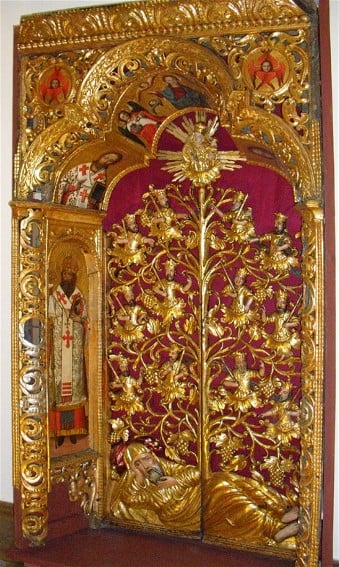
Royal Gates of the Zhovkva iconostasis
Dettagli
Analisi esperta di Royal Gates of the Zhovkva iconostasis di Ivan Rutkovych
Stile: Baroque · Genere: religious painting, icon
The "Royal Gates of the Zhovkva iconostasis" by Ivan Rutkovych exemplifies the fusion of Eastern Orthodox iconographic tradition with the dynamic, ornate aesthetics of the Baroque style—a hallmark of Rutkovych’s innovative workshop in 17th‑century Ukraine. As the central doorway of an iconostasis, the Royal Gates symbolically represent the passage to the sanctuary; in Rutkovych’s hands, this liturgical object becomes a dramatic statement of the Baroque era.
What makes this work significant:
-
Synthesis of Traditions: Rutkovych masterfully blends the rigid, hieratic forms of Byzantine iconography with Baroque movement and emotional intensity. The figures—likely depicting the Annunciation and the four Evangelists, standard for Royal Gates—are rendered with flowing drapery, expressive gestures, and a sense of theatrical immediacy that is distinctly Baroque, yet the gold ground and frontal composition retain the icon’s sacred function.
-
Regional Innovation: Within the context of Ukrainian religious painting, Rutkovych was a pioneer of the “Zhovkva school,” which introduced Western Baroque motifs (such as deeply carved foliage, scrolling vines, and vivid, three‑dimensional ornament) into church art. The Royal Gates from Zhovkva are a prime example of this Rutkovych Baroque—a local adaptation that influenced numerous iconostases across Galicia and Volhynia.
-
Technical Mastery: The work demonstrates meticulous attention to gilded woodcarving and panel painting. The intricate plant‑like tracery surrounding the figurative scenes mirrors the lush, swirling forms found in contemporary European altarpieces, while the palette of rich reds, blues, and burnished gold heightens the sense of celestial glory—a Baroque emphasis on sensory awe.
By integrating Counter‑Reformation dynamism with Orthodox liturgy, Rutkovych’s Royal Gates stand as a pivotal monument of Ukrainian Baroque, marking the moment when Western European stylistic currents were re‑imagined for Eastern Christian sacred space. This makes the work not merely a devotional object but a cultural artifact of cross‑cultural artistic exchange.
Genere
Stile
Visivamente simili
20 opere con composizione e palette affini
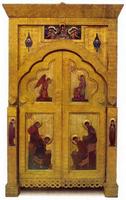
The King's Gate with the gate canopy
Nicholas Roerich
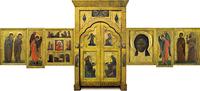
Perm iconostasis
Nicholas Roerich
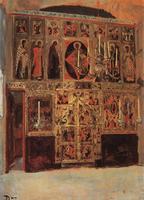
Cathedral of the Annunciation. The aisle of the Blessed Virgin Mary chapel.
Vasily Polenov
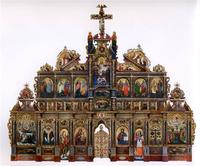
The Maniava Hermitage iconostasis
Yov Kondzelevych
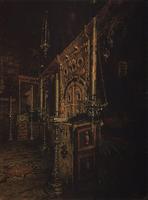
The iconostasis of the church of John the Theologian on Ishna near Rostov Yaroslavsky
Vasily Vereshchagin
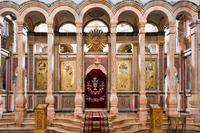
Interior of Church of the Holy Sepulchre, Jerusalem, Israel
Romanesque Architecture
Polyptych
Paolo Veneziano
Iconostasis in the Holy Spirit Chapel of the Greek Catholic Theological Seminary in Lviv (1920s)
Petro Kholodny (Elder)
Inside the Peter and Paul Church in Plyos
Isaac Levitan
Klosterneuburg Altar
Nicholas of Verdun
The service in St. Sophia Cathedral
Pyotr Konchalovsky
Iconostasis
Horia Bernea
Fiery Furnace
Nicholas Roerich
Klosterneuburg Altar
Nicholas of Verdun
Polyptych
Paolo Veneziano
Costume devotion of Fiery Furnace before Christmas Liturgy in Russian Orthodox Church
Nicholas Roerich
Klosterneuburg Altar
Nicholas of Verdun
Klosterneuburg Altar
Nicholas of Verdun
Linaioli Tabernacle
Fra Angelico
Moses on Mount Sinai
Nicholas of Verdun