
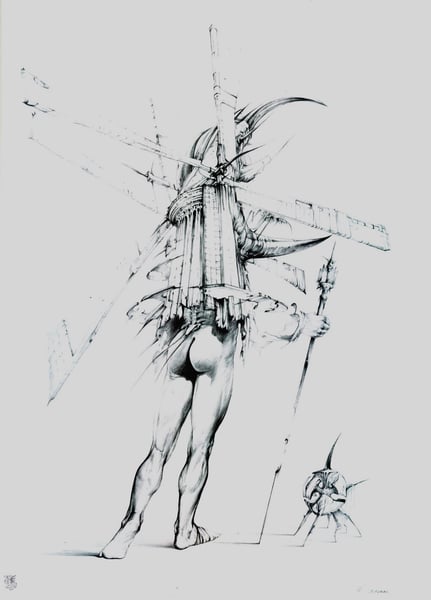
Expert analysis of Wojciech Siudmak’s Don Quixote
Style: Fantastic Realism · Genre: symbolic painting
Analysis of "Don Quixote" by Wojciech Siudmak
Wojciech Siudmak’s Don Quixote is a masterful example of Fantastic Realism, a style that emerged in mid-20th-century Europe as a counterpoint to both abstract expressionism and strict surrealism. Siudmak, a Polish-born painter deeply influenced by the Vienna School of Fantastic Realism, infuses this symbolic painting with a meticulous, almost Old Master technique while conjuring a dreamlike, metaphysical atmosphere.
Significance within Fantastic Realism:
The work exemplifies Fantastic Realism’s core goal: to render the impossible with hyper-realistic precision. Siudmak places the titular knight, Don Quixote, not in the dusty plains of La Mancha but in a surreal, layered cosmos. Floating architectural fragments, celestial orbs, and biomorphic forms surround the figure, blurring the line between waking reality and the hallucinatory visions that drive Quixote’s quest. This technique—precise chiaroscuro and glazing combined with impossible spatial logic—is a hallmark of the style, elevating the painting beyond mere illustration into a meditation on the tension between inner vision and outer reality.
Symbolic depth:
As a symbolic painting, Don Quixote goes beyond the literary source. Siudmak does not simply depict Cervantes’ character; he uses Quixote as an archetype of the visionary, the dreamer who imposes his own narrative on a prosaic world. The hero’s armor is fractured, reflecting the fragility of idealism, while the background—a cosmic void teeming with gears, ruins, and ethereal lights—suggests that his quest is both eternal and doomed. The painting becomes a commentary on the human condition: the struggle to maintain noble purpose in a universe that is indifferent, beautiful, and terrifying.
What makes it significant:
Siudmak’s Don Quixote stands out within Fantastic Realism for its philosophical synthesis. It does not merely show fantasy but symbolizes the act of fantasizing itself. The figure is caught in a moment of suspended motion, as if stepping out of time—a visual metaphor for the artist’s own role in bridging the seen and the unseen. By choosing Quixote, a character whose madness is inseparable from his nobility, Siudmak comments on the creative impulse: art as a form of chivalric quest. The painting thus becomes emblematic of Fantastic Realism’s ambition to reveal the miraculous hidden within the mundane, making it a key work in understanding how the style reanimated allegorical and romantic traditions in a modern, disillusioned age.
Visually similar
20 works with related composition and palette
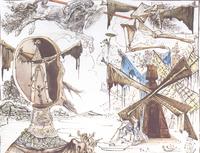
Don Quixote and the Windmills
Salvador Dali
Le Moulin
Amadeo de Souza-Cardoso
The Windmill
Wols
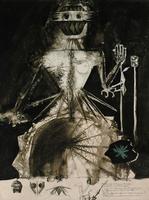
Le grand transparent
Jacques Hérold
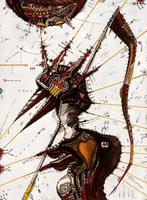
Suite Geometria de la Mort
Joan Ponc
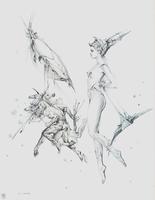
The Vault of Obstacle
Wojciech Siudmak
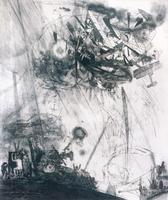
Kondor Béla, Égi Háború
Kondor Béla
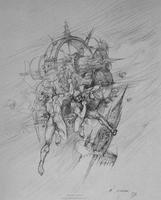
The Wheel Of Time
Wojciech Siudmak
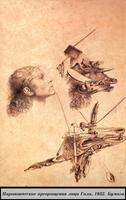
Paranoic Metamorphosis of Gala's Face
Salvador Dali
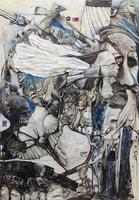
Weltenwandel
Jürgen Bley
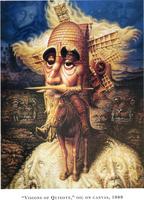
Visions of quixote
Octavio Ocampo
Bild 5
Gerda von Flottwell
Andante (Sonata of the Spring)
Mikalojus Konstantinas Ciurlionis
Character Assasination
David Choe
Kondor Béla, Illusztráciok
Kondor Béla
Kondor Béla, Repülés
Kondor Béla
Kondor Béla, Pokolbeli Nyomda
Kondor Béla
Dial
Wojciech Siudmak
Surviving in the Multidimensional Space of Cognitive Dissonance
Ryota Matsumoto
Untitled
Oyvind Fahlstrom