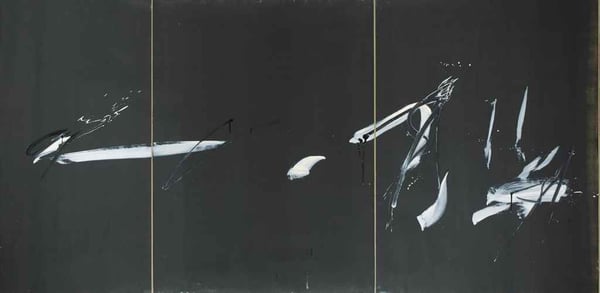
Expert analysis of Jean Degottex’s Hagakure (X)
Style: Minimalism · Genre: abstract
Expert Analysis: "Hagakure (X)" by Jean Degottex
Jean Degottex’s Hagakure (X) stands as a significant work within the broader context of Minimalism and abstract art, particularly for its fusion of reductive formal language with philosophical resonance. Executed in a period when Degottex moved from lyrical abstraction toward a stricter, process-oriented minimalism, this piece exemplifies his unique contribution to the movement—one that is less about geometric purity and more about the interplay between gesture, void, and conceptual depth.
Significance within Minimalism and Abstract Art
-
Minimalist Reduction with Expressive Traces: Unlike the hard-edged, industrial Minimalism of American artists like Donald Judd or Frank Stella, Degottex’s approach retains a tactile, hand-made quality. In Hagakure (X), the “X” likely denotes a series or a structural mark, but the artist’s brushwork—though restrained—is still present. This balances Minimalism’s drive for essential form with the subjective gesture of abstract expressionism, creating a dialogue between control and spontaneity.
-
Philosophical Underpinning: The title Hagakure references the classic Japanese samurai text Hagakure (“Hidden Leaves”), which advocates for the discipline of living with an awareness of impermanence. Degottex, deeply influenced by Zen Buddhism and calligraphy, integrates this Eastern meditation on emptiness and presence into the Western Minimalist grid. The “X” may allude to negation, crossing out, or the sign of a target—mirroring the Zen concept of direct experience stripped of ornament. This makes the work not merely a visual object but a contemplative tool, elevating it beyond pure formalism.
-
Critical Position in 1960s Abstraction: At a time when Minimalism was often perceived as cold and impersonal, Degottex’s Hagakure series reasserted the possibility of spiritual content within severe abstraction. The piece challenges the viewer to see minimal form not as empty, but as charged with intention—a significant counterpoint to both the emotive excess of Abstract Expressionism and the anti-expressive stance of mainstream Minimalism.
In summary, Hagakure (X) is significant because it expands the definition of Minimalism, proving that extreme reduction can be a vessel for profound cultural synthesis and personal expression. Its stark, abstract vocabulary belies a rich conceptual and sensory experience, marking Degottex as a pivotal figure who bridged East and West, gesture and structure, within the minimalist idiom.
Visually similar
20 works with related composition and palette
Composition
Jean Degottex
Untitled
Jean Degottex
Gidayu III
Jean Degottex
Untitled
Fritz Winter
Sacrifice
Friedel Dzubas
Opus 110
Gerard Schneider
Reds
Basil Beattie
Buttress
Franz Kline
Untitled
Jean Degottex
Jaillir
Jean Miotte
Untitled
Cy Twombly
Untitled
Luis Feito
Untitled
Gerard Schneider
Free Simulation Consciousness #5050W13
SHIH,SIAO-MO
Screen I (diptych)
Kenzo Okada
Composition
Afro
Écriture
Jean Degottex
Le Duc Charles épouse la Duchesse de Bourgogne
Georges Mathieu
Suite Obscure V
Jean Degottex
Adam and Eve (4)
Pietro Lazzari