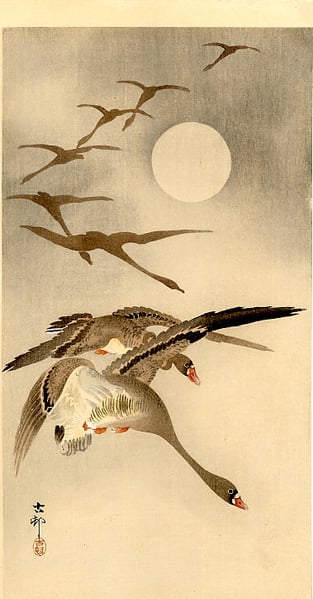
Analisi esperta di Eight White-fronted Geese in Flight; full Moon behind di Ohara Koson
Stile: Shin-hanga · Genere: wildlife painting
Expert Art Historical Analysis
"Ohara Koson’s Eight White-fronted Geese in Flight; full Moon behind is a masterwork of the Shin-hanga movement, demonstrating the style’s defining fusion of traditional Japanese woodblock aesthetics with Western naturalism. Koson was a leading figure in kachō-e (bird-and-flower pictures), and this print exemplifies his ability to imbue wildlife with both scientific accuracy and poetic serenity.
Composition & Technical Significance: The artwork captures a precise moment: eight geese ascending against a luminous full moon. Koson’s composition masterfully balances the dark silhouettes of the geese with the soft glow of the moon, using the negative space of the sky to create a sense of depth and motion. The birds are arranged in a dynamic, slightly staggered V-formation—a hallmark of Shin-hanga’s commitment to observed realism. Each goose is rendered with distinct posture and wing angles, reflecting Koson’s careful study of avian anatomy.
Shin-hanga Innovation: Unlike traditional ukiyo-e, which often stylized nature, Shin-hanga artists like Koson incorporated Western perspective, atmospheric effects, and subtle gradations of color (bokashi). Here, the moon’s halo and the fading twilight sky rely on intricate woodblock printing techniques, with multiple color blocks creating a seamless transition from pale gold to deep indigo. The geese themselves are carved in bold, flat areas of black ink, contrasting with the tonal richness of the background—a signature Koson device that heightens dramatic tension.
Cultural & Symbolic Weight: In Japanese art, geese (often paired with the moon) symbolize autumn, transience, and the fleeting beauty of nature. Koson’s rendering elevates this traditional motif through a transparent, almost cinematic realism. The geese’s synchronized flight suggests harmony with natural cycles, while the full moon anchors the composition as a timeless, cyclopean witness.
Legacy: This print ranks among Koson’s most celebrated works, quietly redefining kachō-e for modern audiences. It bridges the decorative elegance of Edo-period prints with the observational precision of modern natural history illustration, securing Koson’s place as a pivotal figure in early 20th-century Japanese printmaking."
Visivamente simili
20 opere con composizione e palette affini
Flying white-fronted goose seen from underneath in front of the moon
Ohara Koson
White-fronted goose descending over reeds
Ohara Koson
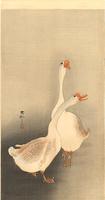
Two white geese
Ohara Koson
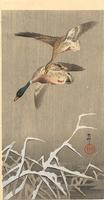
Mallards
Ohara Koson
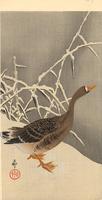
Goose on the snow
Ohara Koson
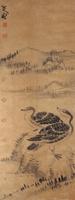
Two Wild Geese
Bada Shanren
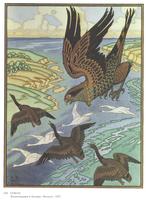
Falcon. Illustration for the epic "Volga"
Ivan Bilibin
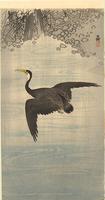
Cormorant
Ohara Koson
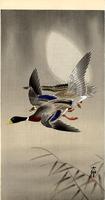
Mallards and Moon
Ohara Koson
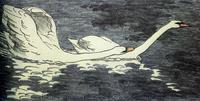
Farbiger Holzschnitt Zwei Schwäne
Otto Eckmann
Heggren
Theodor Severin Kittelsen
Goose
Ding Yanyong
Flowers and Birds of the Four Seasons
Kanō Motonobu
Pheasant/Three men with umbrellas
Shibata Zeshin
Cranes
Huang Yongyu
The Swan (No. 1)
Hilma af Klint
Egret
Lin Fengmian
White Birds in Snow
Ohara Koson
Swans (in situ)
Alfred Freddy Krupa
Crane over his nest
Ohara Koson