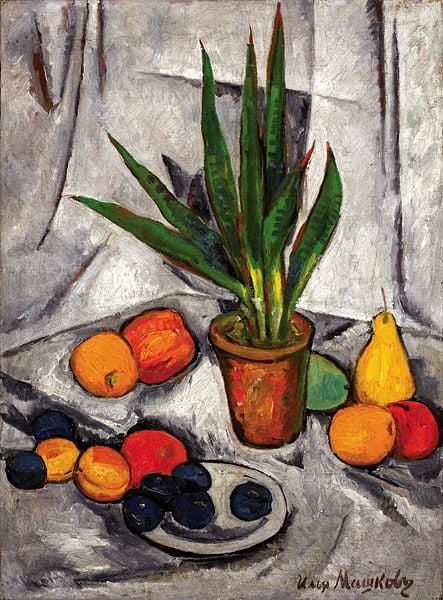
Still life with plants and fruit
Analisi esperta di Still life with plants and fruit di Ilya Mashkov
Stile: Fauvism · Genere: still life
Expert Analysis: "Still life with plants and fruit" by Ilya Mashkov
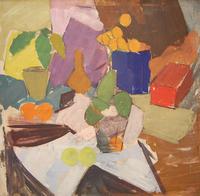
As a work firmly rooted in Fauvism, Ilya Mashkov’s Still life with plants and fruit exemplifies the movement’s radical departure from naturalistic representation, embracing instead an explosion of pure, unmodulated color and energetic brushwork. The still-life genre—traditionally a vehicle for meticulous rendering or symbolic meditation—is here transformed into a dynamic, almost theatrical arena where form is subjugated to chromatic intensity.
Mashkov, a key figure in the Russian avant-garde group the Jack of Diamonds, drew on both Western Fauvist innovations (Matisse, Derain) and vernacular folk traditions, resulting in compositions of deliberate, robust simplicity. In this painting, the fruits and plants are not rendered with delicate gradation but are built from broad, flattened planes of vivid reds, greens, oranges, and blues. The contours are simplified, and the spatial depth is compressed—a hallmark of Fauvist still life—so that the objects seem to push forward, asserting their material presence.
The significance of this work lies in its aggressive liberation of color. Where earlier Fauvists delighted in the harmony of bright hues, Mashkov pushes further into dissonance, pitting complementary colors against one another to generate a raw, almost jarring visual energy. The “plants” and “fruit” become mere pretexts for a sensory overload, a celebration of paint itself. This aligns with the Fauvist credo that color should function independently of descriptive duty—here, a lemon might be violet, a leaf scarlet, simply because the composition demands it.
Furthermore, Mashkov’s brushwork is deliberately coarse and direct, an affront to academic polish. Thick impasto and visible strokes reinforce the materiality of the canvas, making the act of painting as important as the depicted subject. In this, the work stands as a testament to Fauvism’s late, more radical phase—often called “Russian Fauvism”—where peasant art, icon painting, and Western modernism fused into a uniquely boisterous, earthbound aesthetic.
Thus, Still life with plants and fruit is significant not only as a vibrant example of Fauvist still life but also as a marker of how the movement evolved beyond its French origins, absorbing local traditions to produce a more visceral, unrefined, and emotionally direct artistic statement. It is a celebration of color for color’s sake, a rebellion against naturalism, and a key artifact in understanding the cross-pollination of Russian and European modernism.
Visivamente simili
20 opere con composizione e palette affini
Still Life
Kmetty János
Still life with Sansevierie
Gazmend Freitag
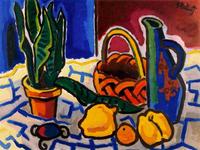
Still Life (Sanseveria and Jar)
Karl Schmidt-Rottluff
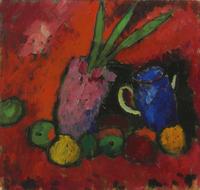
Still Life
Alexej von Jawlensky
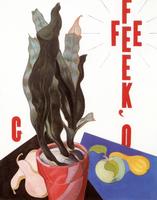
O'Keefe (Georgia O’Keeffe)
Charles Demuth
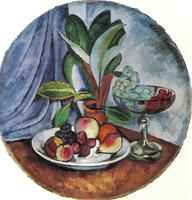
Still Life with Cactus
Ilya Mashkov
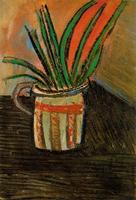
Exotic Flowers
Pablo Picasso
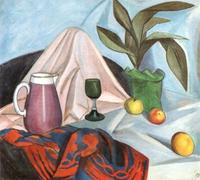
Stillife
Robert Falk
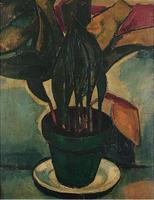
Czóbel Béla Still Life
Bela Czobel
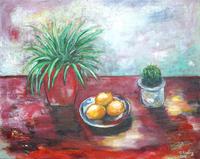
Stillife - Three oranges
Gazmend Freitag
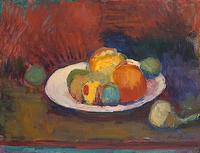
Assiette De Fruits (Fruit Dish)
Henri Matisse
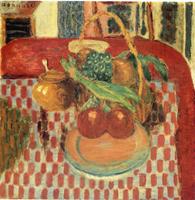
Basket and Plate of Fruit on a Red Checkered Tablecloth
Pierre Bonnard
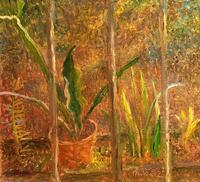
Autumn Warmth
Tetyana Yablonska
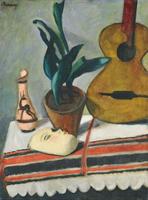
Berény Róbert, Csendélet Gitárral Maszkal 1926
Berény Róbert
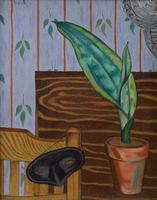
Still Life with Mask
O. Louis Guglielmi
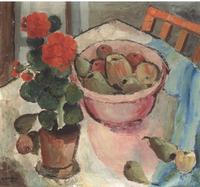
Stillleben mit Geranien und Schale
Helen Dahm
Bowl with Apples
Roman Selsky
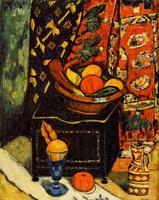
Still Life, No. 1
Marsden Hartley
Opstilling. Udateret
Edvard Weie
A Plant for Elizabeth
Robert Brackman