Jean Fautrier sanatçısının Fleures noires eseri hakkında uzman analizi
Tarz: Abstract Art · Tür: still life
Expert Analysis: Fleures noires (c. 1940s) by Jean Fautrier
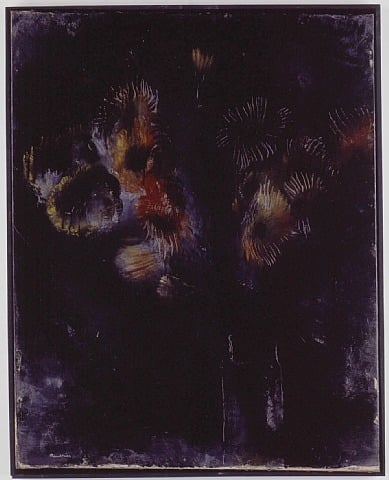
Jean Fautrier’s Fleures noires (“Black Flowers”) stands as a pivotal work within the artist’s radical redefinition of still life and a touchstone of European Art Informel. Created during the same period as his more famous Hostages series, this painting transcends the traditional still-life genre to become a visceral meditation on materiality, memory, and the aftermath of war.
Significance as Abstract Still Life Fautrier subverts the serene, objective conventions of 20th-century still life. Instead of clearly delineated blooms, he presents a nearly illegible cluster of dark, bulbous forms that hover between organic decay and raw pigment. The title implies fragile vegetation, yet the execution is anything but delicate: thick, pasty impasto—often mixed with plaster or glue—is gouged, smeared, and built up into a crusty, pitted surface. This tactile aggression, a hallmark of his haute pâte technique, turns the canvas into a scarred, skin-like field. The “flowers” become writhing, almost bruised entities, evoking both the beauty of nature and the horror of ruined flesh.
Placement within Art Informel Fautrier was a pioneer of Art Informel, the European parallel to American Abstract Expressionism. Where the latter emphasized heroic gesture, Fautrier’s work—as seen in Fleures noires—privileges ground over figure, matter over representation. The dark, limited palette of blacks, grays, and deep browns creates a claustrophobic, nocturnal atmosphere. The painting refuses easy optical pleasure, demanding instead a corporeal, almost tactile engagement. In his hands, the still life is drained of all illusionistic depth; the flowers are not depicted but become the material residue of an event.
Post-War Resonance The date of Fleures noires is crucial: it emerges from the trauma of World War II. Fautrier’s Hostages series directly referenced victims of Nazi executions. Here, the “black flowers” function as a more coded, yet equally potent, memento mori. The rotting floral forms mimic the decomposition of organic life, transforming a genre of beauty into an emblem of mortality and resilience. The painting’s significance lies in its ability to make the abstract feel viscerally specific—each clotted stroke is a record of an emotional or historical scar.
Conclusion Fleures noires is not merely an abstract still life; it is a manifesto of matter as meaning. By pushing the genre into the realm of the abject, the gestural, and the material, Fautrier dismantles centuries of botanical representation. The work’s power resides in its tension: flowers that are “black,” life that is torn, form that disintegrates into stuff. It remains a cornerstone of European abstraction, proving that still life could become a profound vehicle for existential and historical weight.
Tür
Stil
Görsel olarak benzer
İlişkili kompozisyon ve renk paletine sahip 20 eser
Untitled
Artin Demirci
Untitled
Richards Ruben
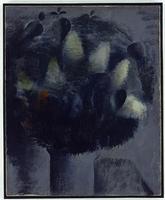
Le lilas blanc
Jean Fautrier
Light and Shadow
Tetyana Yablonska
Banquo's Funeral (Flowers N°4)
Tony Scherman
Czóbel Béla Still Life 1946
Bela Czobel
Czobel Bela Virágok Korsóban
Bela Czobel
Figure and Flowers
Charles Blackman
Czóbel Béla Csendélet....
Bela Czobel
Figure and Flowers
Charles Blackman
Czóbel Béla Virágok
Bela Czobel
Still Life
Bela Czobel
Yellow Flowers
Francisc Sirato
Czóbel Béla Csendélet, 63x43cm
Bela Czobel
Untitled
Menez
Virágcsendélet
Bela Czobel
Composition
Jean Le Moal
Czóbel Béla Asztali Csendélet 50x40cm
Bela Czobel
Tracking Athabasca; Short Lines, Network of Stoppages
Landon Mackenzie
Flori
Ion Pacea