
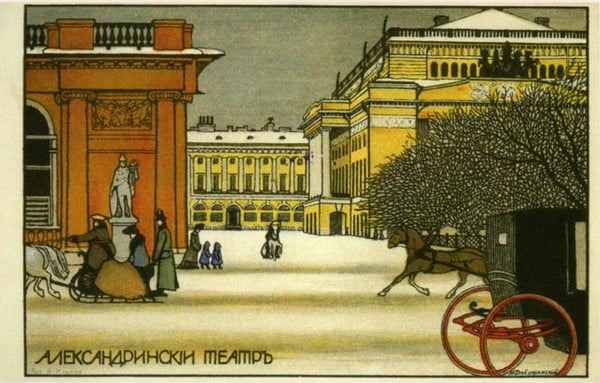
Alexandrinsky Theatre
Ayrıntılar
Mstislav Dobuzhinsky sanatçısının Alexandrinsky Theatre eseri hakkında uzman analizi
Tarz: Art Nouveau (Modern) · Tür: cityscape
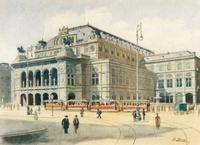
Expert Analysis: "Alexandrinsky Theatre" by Mstislav Dobuzhinsky
Artist & Context: Mstislav Dobuzhinsky (1875–1957) was a leading figure in the Russian Mir iskusstva (World of Art) group, which championed a synthesis of Art Nouveau elegance, Symbolist mood, and national heritage. His cityscapes—particularly of St. Petersburg—are renowned for capturing the city’s architectural grandeur through a distinctly modern, decorative lens.
Significance within Art Nouveau (Modern):
- Stylized realism: Dobuzhinsky transforms the iconic Alexandrinsky Theatre into a rhythmic composition of elegant lines and flattened planes, a hallmark of Art Nouveau’s rejection of strict naturalism. The building’s neoclassical façade is reinterpreted through sinuous curves and delicate detailing, marrying historical monumentality with the movement’s decorative sensibility.
- Atmospheric urbanism: The work exemplifies how Art Nouveau cityscapes evoke a specific zeitgeist—here, the twilight or evening lighting (common in Dobuzhinsky’s scenes) creates a poetic, slightly melancholic mood. The play of shadows and the stylized street lamps align with the movement’s fascination with artificial light and urban spectacle.
- Focus on line and pattern: The composition emphasizes verticality and ornamental rhythms (windows, columns, railings), turning the theatre into a surface patterned with elegant arabesques. This reflects Art Nouveau’s core principle: architecture as a total work of art, where every element contributes to a harmonious visual melody.
Genre & Thematic Weight: As a cityscape, the painting is not merely topographical but psychological. Dobuzhinsky’s treatment of the Alexandrinsky—the historic home of Russian drama—suggests a theater of the city itself: the street becomes a stage, and the architecture a backdrop for modern life. This mirrors the Mir iskusstva group’s obsession with the theatricality of St. Petersburg, blending memory, literature, and contemporary aesthetics.
Why It Matters: Dobuzhinsky’s Alexandrinsky Theatre bridges the 19th-century tradition of architectural capriccio and the 20th-century avant-garde’s bold abstraction. It demonstrates how Art Nouveau could infuse a classical subject with newfound emotional resonance and graphic boldness, securing Dobuzhinsky’s legacy as a master of the urban landscape modernisé—where the city breathes through line, light, and mood.
Görsel olarak benzer
İlişkili kompozisyon ve renk paletine sahip 20 eser
Plac Teatralny W Warszawie
Marcin Zaleski
Illumination of the Theatre Square in 1856
Vasily Sadovnikov
The Moscow University
Konstantin Yuon
Admiralty under the snow
Anna Ostroumova-Lebedeva
The New Opera and Gustav Adolf Square
Anna Palm de Rosa
View of the Anichkov Palace
Vasily Sadovnikov
Departure of an Omnibus from St. Isaac's Square in St. Petersburg
Vasily Sadovnikov
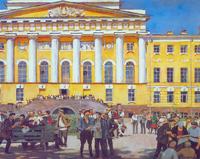
Students
Konstantin Yuon
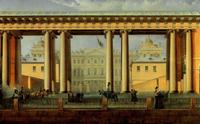
View of the Anichkov Palace from the Fontanka River
Vasily Sadovnikov
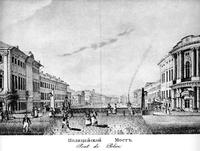
Policeman bridge in the 1830s, now Green Bridge
Vasily Sadovnikov
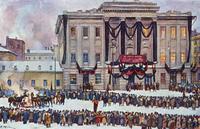
In those days. At the House of Unions in the days of Lenin's funeral
Konstantin Yuon
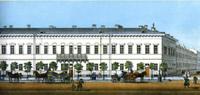
Demidov hotel. Fragment of "Panorama of Nevsky Prospect"
Vasily Sadovnikov
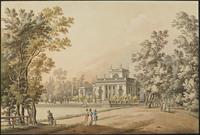
Lazienki Park, the view from the south
Zygmunt Vogel
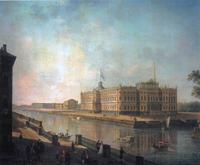
View onto St. Michael's Castle in St. Petersburg from the Fontanka Side
Fyodor Alekseyev
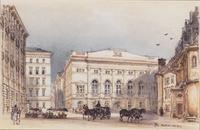
Lower Austrian country house in Vienna Viewed from Minoritenplatz
Rudolf von Alt
View of Saint Michael's Castle
Fyodor Alekseyev
Entrance into Verkiai Palace, Vilnius, Lithuania
Vasily Sadovnikov
Military Parade of Emperor Paul in front of Mikhailovsky Castle
Alexandre Benois
Officers of the Prussian Army in the Opernplatz, Berlin
August Neigelsohn
Vienna State Opera House
Adolf Hitler