
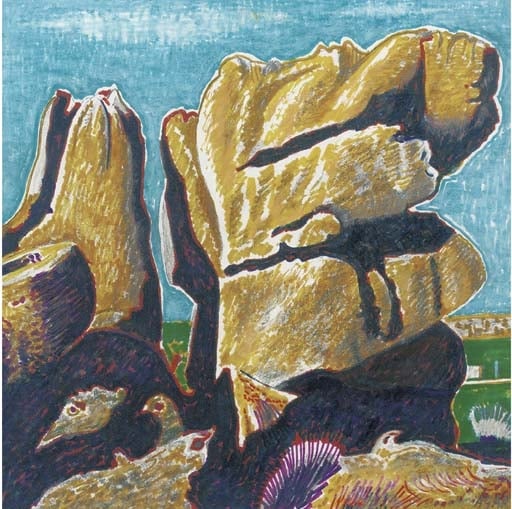
Ploumanach
Analisi esperta di Ploumanach di Eileen Agar
Stile: Post-Impressionism · Genere: landscape
Expert Analysis: "Ploumanach" by Eileen Agar
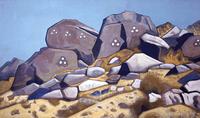
Eileen Agar’s Ploumanach (c. 1930s) is a striking Post-Impressionist landscape that captures the dramatic coastline of Ploumanac’h in Brittany, France—a region celebrated for its distinctive pink granite rock formations and rugged seascapes. While Agar is best known for her later Surrealist works, this painting exemplifies her early engagement with Post-Impressionist principles, bridging the movement’s emphasis on emotional and symbolic expression with her own developing visual language.
Significance within Post-Impressionism:
The work is significant for its bold departure from naturalistic representation, a hallmark of Post-Impressionism. Agar employs vibrant, unmodulated colors—deep blues, fiery oranges, and earthy reds—to convey the raw energy of the coastal scene rather than a literal transcription. The brushwork is expressive and rhythmic, with thick, directional strokes that evoke the texture of weathered stone and the restless motion of the sea. This technique aligns with the Post-Impressionist goal of conveying subjective emotion and inner vision, as seen in the works of Cézanne, Van Gogh, or Gauguin, who influenced Agar’s early palette.
Artistic Context and Innovation:
What makes Ploumanach particularly notable is how Agar infuses the landscape with a proto-Surrealist sensibility. The composition is slightly distorted: the granite boulders seem to pulse with organic, almost biomorphic forms, and the horizon is tilted, creating a sense of unease or dreamlike disorientation. This prefigures her later Surrealist explorations of metamorphosis and the unconscious. As a female artist working in a male-dominated field, Agar’s confident handling of a traditionally masculine genre—the rugged coastal landscape—challenges gender norms. The painting also reflects the period’s interest in “primitive” or elemental forces, using Post-Impressionist simplification to connect modern art with raw natural power.
Legacy:
Ploumanach stands as a testament to Agar’s versatility and her ability to synthesize movements. It demonstrates Post-Impressionism’s enduring capacity for innovation, particularly when filtered through a unique artistic sensibility. The work is a vital example of how women artists of the early 20th century contributed to and expanded the stylistic boundaries of Post-Impressionism, paving the way for more experimental, genre-bending approaches.
Visivamente simili
20 opere con composizione e palette affini
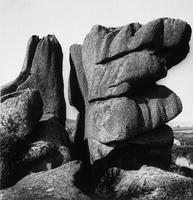
Rocks at Ploumenach, Brittany
Eileen Agar
Fjellknaus
Knud Baade
Ayrivank red stones
Mariam Aslamazian
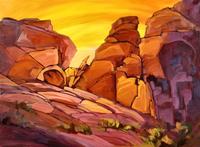
Valley of Fire
Erin Hanson
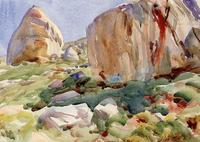
The Simplon. Large Rocks
John Singer Sargent
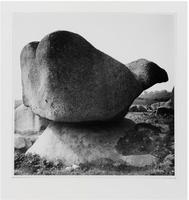
Bum-Thumb Rock, Ploumanach, Brittany
Eileen Agar
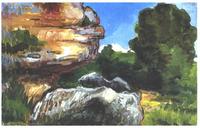
Rocks
Paul Cezanne
Namaqualand in Spring
David Botha
Arzni
Martiros Sarian
View from Pellinge
Tove Jansson
Study of a Rock
Asher Brown Durand
Nature Scene - DinksFãStan Private Collection
Conrad Theys
Shara-Muren
Nicholas Roerich
Gurzuf. Rocks
Ivan Shishkin
View of Geelong, the Corio Bay and Indented Heads from the southern declivity of Station Peak
Eugene von Guerard
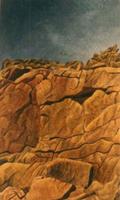
Rocks
Godfrey Blow
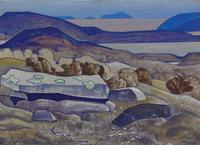
Stone of the Leader
Nicholas Roerich
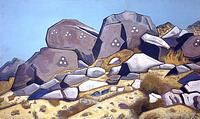
Tibet
Nicholas Roerich
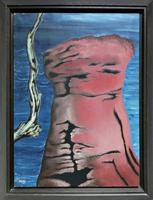
Magnerova Zena(mafnetic Woman)
Toyen
Rocks of Mongolia
Nicholas Roerich