
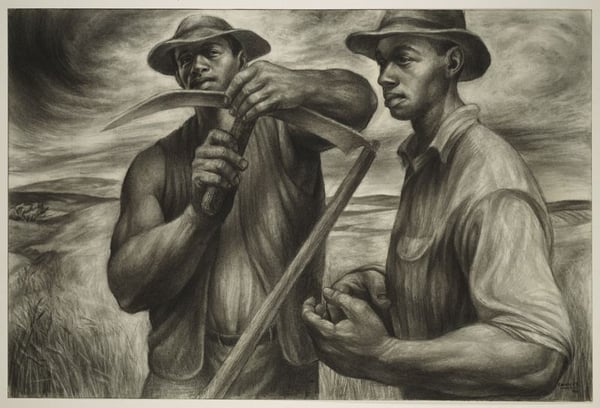
Harvest Talk
Analisi esperta di Harvest Talk di Charles Wilbert White
Stile: Social Realism · Genere: genre painting
Expert Analysis: "Harvest Talk" by Charles Wilbert White
Context and Style
Charles Wilbert White (1918–1979) was a master of Social Realism, a movement that emerged in the 1930s–40s as a direct response to economic hardship, racial injustice, and the dignity of working people. Unlike the more propagandistic vein of Soviet Socialist Realism, American Social Realism—and White’s work in particular—centered on the intimate, everyday lives of marginalized communities, elevating their humanity through monumental composition and meticulous draftsmanship.
Visual and Compositional Significance
Harvest Talk is a genre painting: a scene of ordinary life. White depicts two agricultural laborers pausing from their work, engaged in conversation. The title suggests not merely a break, but a moment of communal exchange—sharing news, advice, or solidarity. The figures are likely African American sharecroppers or field workers, a subject White returned to throughout his career to counter demeaning stereotypes with images of strength, introspection, and mutual support.
White’s handling of form is crucial. He often worked in charcoal, ink, or graphite, building rich tonal contrasts that give his figures a sculptural, heroic weight. The composition is intimate yet monumental: the figures fill the frame, their bent postures and clasped hands suggesting both exhaustion and resilience. The background is typically minimal, focusing attention on the faces and gestures—the real “harvest” is human connection.
Significance within Social Realism and Art History
White’s Harvest Talk is significant because it:
-
Humanizes the laborer – Where many Social Realists emphasized the machine or the mass of workers, White insists on individual dignity. Each face carries a specific narrative of endurance and hope.
-
Challenges racial erasure – In the 1940s–50s, American art largely ignored Black rural life. White’s genre scenes gave African American agricultural workers a place in fine art that was neither exoticized nor patronized.
-
Bridges community and political consciousness – The “talk” in the title implies the oral tradition and covert planning that sustained the Civil Rights Movement. A quiet conversation in the fields becomes a revolutionary act of solidarity.
-
Exhibits technical mastery – White’s cross-hatching, controlled shading, and ability to convey texture (rough hands, worn clothing, sunlit skin) make the work a textbook example of Social Realist draftsmanship.
Conclusion
Harvest Talk is not merely a record of rural life; it is a political and humanist statement. Charles White used the vocabulary of Social Realism to assert that the most profound struggles and triumphs happen not in parades or protests, but in the quiet, shared moments of people who sustain each other through labor and language. The work remains a powerful testament to the dignity of Black workers and the enduring importance of community in the face of systemic oppression.
Visivamente simili
20 opere con composizione e palette affini
Vasil and Mykola Shufletyuk
Georgyi Yakutovytch
Peasant with Sickle
Vincent van Gogh
Czene Béla, Kaszálók 1942
Czene Béla
Gadanheiro
Julio Pomar
Sweat
Vela Zanetti
Reaper
Vincent van Gogh
Tools for masonry and agriculture
Giovanni Battista Piranesi
Farmer
Norman Rockwell
Zwei Bergmäher (zweite Fassung)
Albin Egger-Lienz
Contadini al lavoro
Renato Guttuso
Zolfataro
Renato Guttuso
The Age
Vela Zanetti
The working mower
Ferdinand Hodler
Two Mowers
Albin Egger-Lienz
The Mower
Albin Egger-Lienz
Untitled
Hélène de Beauvoir
Scheiber Hugó, Lépő Férfi
Scheiber Hugó

The Mower
Albin Egger-Lienz
The Reaper
Ferdinand Hodler
The Reaper
Ferdinand Hodler