
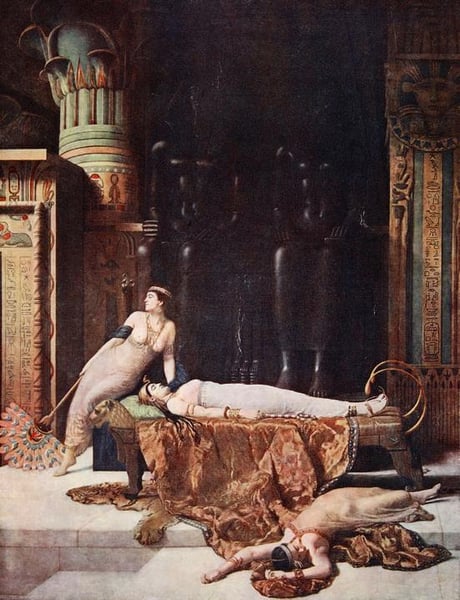
Expertenanalyse zu John Colliers The Death of Cleopatra
Stil: Romanticism · Genre: history painting
Expert Art Historical Analysis: "The Death of Cleopatra" by John Collier
As a Romantic history painting, John Collier's The Death of Cleopatra derives its significance from the movement's obsession with intense emotion, dramatic climax, and the sublime power of individual tragedy. Romanticism sought to elevate personal experience and historical drama above neoclassical restraint, and Collier's choice of Cleopatra's final, self-willed moment perfectly embodies this ethos.
The work captures the precise instant when the legendary queen, having chosen suicide over humiliation, embraces death. In Romantic tradition, this is not a quiet departure but a scene of heightened pathos and psychological tension—Cleopatra's regal defiance is paired with the fatal intimacy of the asp's bite. The genre of history painting, traditionally reserved for moral or civic lessons, is here repurposed to explore a deeply personal, sensual, and morbidly beautiful end. Collier emphasizes the exoticism and Orientalist allure of the subject, a common Romantic fascination with ancient Egypt, while also foregrounding the emotional weight of a sovereign's final act of autonomy.
The painting’s significance lies in how it distills Romanticism’s core values: the celebration of individual will against fate, the fascination with death as a sublime spectacle, and the use of historical narrative to probe universal human passions. Collier’s depiction makes Cleopatra’s death not merely a historical footnote, but a timeless emblem of tragic grandeur—a hallmark of Romantic history painting.
Genre
Stil
Visuell ähnlich
20 Werke mit ähnlicher Komposition und Farbpalette
The Death of Cleopatra
Juan Luna
Death of Cleopatra
Jean-André Rixens
Cleopatra and Caesar
Jean-Leon Gerome
Pharaoh's Handmaidens
John Collier
The Egyptian Widow
Sir Lawrence Alma-Tadema
Cleopatra Testing Poisons on Those Condemned to Death
Alexandre Cabanel
The Fortune Teller's Tale
Anatolio Scifoni
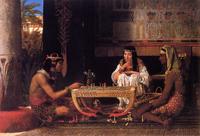
Egyptian Chess Players
Sir Lawrence Alma-Tadema
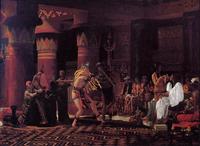
Pastimes in Ancient Egyupe 3 000 Years Ago
Sir Lawrence Alma-Tadema
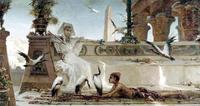
Cleopatra
Wilhelm Kotarbinski

Prodigal Son
Vasily Polenov
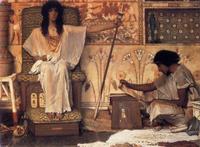
Joseph, Overseer of Pharaoh`s Graneries
Sir Lawrence Alma-Tadema
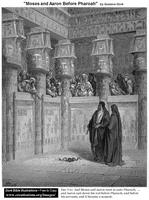
Moses and Aaron Before Pharaoh
Gustave Dore

Phedre
Alexandre Cabanel
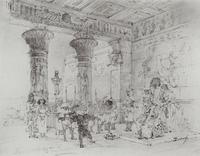
Pharaoh's Palace
Vasily Polenov
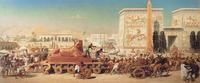
Israel in Egypt
Edward Poynter
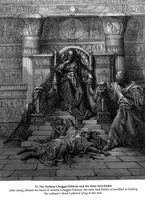
The Sultana Chegger-Eddour and the Emir Saif-Eddin
Gustave Dore
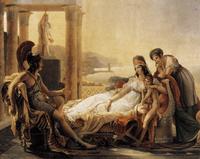
Aeneas Tells Dido the Misfortunes of the Trojan City
Pierre-Narcisse Guerin
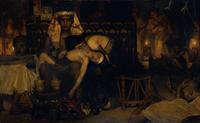
Death of the Pharaoh Firstborn son
Sir Lawrence Alma-Tadema
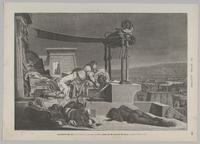
The Bearer of Bad Tidings (from Le Monde Illustré)
Jean Lecomte du Nouÿ