

Analisi esperta di The Priestess of Bacchus di John Collier
Stile: Romanticism · Genere: mythological painting
As an expert art historian, I will analyze "The Priestess of Bacchus" by John Collier using only the provided facts: the work is a mythological painting created within the Romanticism style.
Significance within Romanticism and Mythological Painting:
John Collier’s The Priestess of Bacchus stands as a quintessential example of Romanticism’s fascination with the sublime, the exotic, and the untamed forces of nature and human emotion. The painting’s significance lies in how it uses the classical subject of Bacchus (the Roman god of wine, ecstasy, and ritual madness) to explore deeply Romantic ideals—namely, the liberation of the individual from societal restraint and the intoxicating, dangerous allure of primal instinct.
-
Emotion and Sensuality over Reason: In the Romantic tradition, the priestess is not a passive, idealized figure of Neoclassical decorum. Instead, she embodies the spirited, ecstatic, and potentially chaotic energy of Bacchic worship. The focus on her role as a "priestess" emphasizes a direct, personal connection to the divine through emotional and physical abandon—a core Romantic reaction against Enlightenment rationalism. Her gaze, posture, and the implied movement would likely convey a state of trance or fervor, making the invisible force of divine madness visible to the viewer.
-
Exoticism and the Ancient World: Romantic painters often turned to ancient mythology not for sterile historical accuracy, but to access a world of heightened passion and mystery. Collier’s choice of a Bacchic subject taps into the Romantic taste for the "other"—the pagan, the orgiastic, the mysterious rites of antiquity. This is a mythological painting that serves as a vehicle for exploring the darker, more thrilling aspects of human psychology, which the Romantically inclined mind found more compelling than the calm heroics of earlier classical art.
-
Dramatic Subject and Visual Impact: Romanticism prizes dramatic tension and visceral impact. A priestess of Bacchus is inherently a dramatic figure—caught between the human and the divine, order and chaos. Collier’s work likely leverages rich, intense colors (the warm reds and purples of wine and dusk) and a composition that suggests momentary action or climax, drawing the viewer into the scene’s emotional intensity. The genre of mythological painting is thus elevated from mere illustration to a study of ecstasy and spiritual transcendence.
In summary: The Priestess of Bacchus is significant because it harnesses Romanticism’s core preoccupations—emotional excess, the allure of the irrational, and the power of ancient myth to mirror modern desires—within the framework of a mythological scene. It transforms a classical ritual into a Romantic portrait of inner liberation and the sublime terror of the divine.
Visivamente simili
20 opere con composizione e palette affini
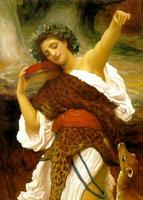
Bacchante
Frederic Leighton
Cherries
Sir Lawrence Alma-Tadema
Mischief and Repose
John William Godward
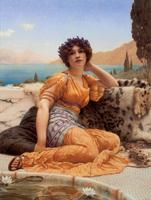
With Violets Wreathed and Robe of Saffron Hue
John William Godward
By the Blue Ionian Sea
John William Godward
Ionian Dancing Girl
John William Godward
When Flowers Return
Sir Lawrence Alma-Tadema

Her First Jewels
William-Adolphe Bouguereau

Sweet Dreams
John William Godward
Daphnis and Chloe
Elizabeth Jane Gardner
The Old, Old Story
John William Godward

Youth and Time
John William Godward
Lamia
John William Waterhouse
Amaryllis
John William Godward
A Classical Beauty
John William Godward

Nero at Baiae
Jan Styka
A Quiet Pet
John William Godward
Promise of Spring
Sir Lawrence Alma-Tadema
A Nymph In The Forest
Charles-Amable Lenoir
Psyche with Putti
Guillaume Seignac