
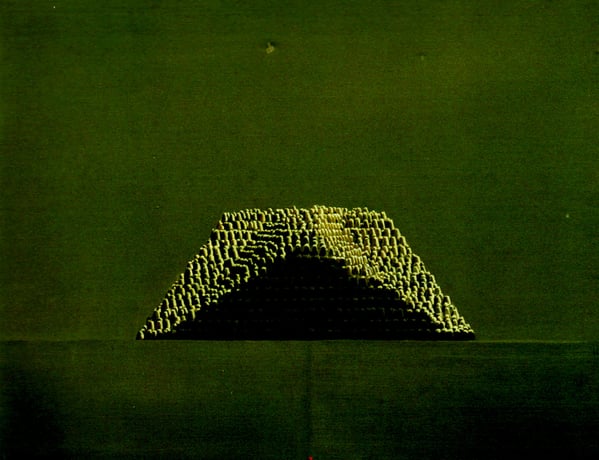
Expert analysis of Horia Damian’s Mastaba
Style: Minimalism · Genre: sculpture
Expert Description of "Mastaba" by Horia Damian
Style: Minimalism
Genre: Sculpture
Significance within Minimalism
"Mastaba" stands as a quintessential example of Minimalist sculpture, a movement that emerged in the 1960s as a radical departure from Abstract Expressionism’s emotive gesture and from traditional figurative sculpture. Minimalism sought to strip art to its essential physical properties—often simple geometric forms, industrial materials, and a rejection of narrative or symbolic content. Horia Damian’s piece directly engages with these core tenets.
The title “Mastaba” refers to the ancient Egyptian rectangular, flat-roofed tomb structures—a reference that anchors the work in architectural and archaeological history. However, Damian’s treatment is thoroughly Minimalist: the sculpture reduces the mastaba form to its most elemental geometry—a pure, unadorned prismatic block or stepped shape. The work emphasizes material presence over representation. Likely executed in a manufactured substance such as steel, concrete, or polished stone, “Mastaba” foregrounds its own objecthood.
What makes it significant:
-
Primary Geometric Form – Minimalist sculptors like Donald Judd, Carl Andre, and Robert Morris championed the “specific object”—a three-dimensional work that is neither painting nor conventional sculpture. Damian’s “Mastaba” belongs to this lineage: its clear, unitary shape (a rectangular solid or a simplified step pyramid) resists internal composition, encouraging the viewer to perceive the work as a whole in space.
-
Architectural Engagement – By appropriating the mastaba’s ancient architectural archetype, the sculpture bridges Minimalism’s interest in modular, serial forms with the history of built structures. The piece does not imitate a tomb; it is a minimalist block that echoes that typology. This creates a dialogue between the timeless, silent geometry of the artwork and the viewer’s spatial environment.
-
Emphasis on Physicality – In true Minimalist fashion, “Mastaba” demands that the viewer confront its literal weight, surface, and scale. The work likely relies on repetition either of identical units (if modular) or on a single mass. This focus on materiality and spatial presence—rather than on artistic expression—defines the significance of the piece within the Minimalist canon.
-
Reduction as Content – The work’s power lies in what is subtracted: any decorative detail, narrative reference, or subjective touch. By paring down to an essential form, Damian makes the shape itself the subject. This radical reduction forces the audience to experience the sculpture in real time and space, aligning with Minimalism’s goal of “one thing after another” and its rejection of illusion.
In summary, “Mastaba” by Horia Damian is a significant Minimalist sculpture because it distills an ancient architectural motif into a pure, self-referential object. It exemplifies the movement’s core values—simplicity, seriality, material honesty, and direct phenomenological encounter—while also nodding to art history’s deep past.
Visually similar
20 works with related composition and palette
Lento sfumato 3
Lech Jankowski

The Pyramids and the Sphynx of Gizeh
Salvador Dali
Resurrection
Oleksandr Aksinin
Numbers Chronos
Oleksandr Aksinin
Bush Hen Dreaming
Abie Loy Kemarre

Fantasia n. 83
Galliano Mazzon
Mountain Devil Lizard
Kathleen Petyarre
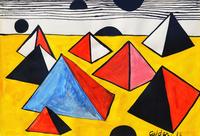
Pyramids
Alexander Calder
Desmaterialização - Ascensão
Eduardo Nery
Paris dream
Max Ernst
Alegro (Sonata of the Pyramids)
Mikalojus Konstantinas Ciurlionis
Illustration for Nichita Stanescu's Knots and Signs
Sorin Dumitrescu
Great Pyramid
Abdul Mati Klarwein
Constructie
Gil Nicolescu
Prapor
Horia Bernea
Conversation with the Blue Caterpillar. Alice in Wonderland
Oleksandr Aksinin
Crystalline Landscape
Paul Klee
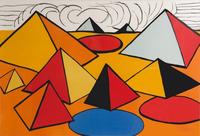
Pryamids and Clouds
Alexander Calder
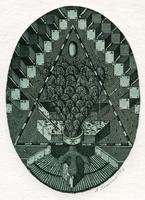
Exlibris of U.Stepanov
Oleksandr Aksinin
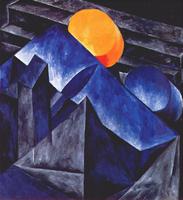
Composition
Natalia Goncharova