Analisi esperta di Gelmeroda V di Lyonel Feininger
Stile: Expressionism · Genere: cityscape
Expert Analysis: "Gelmeroda V" by Lyonel Feininger
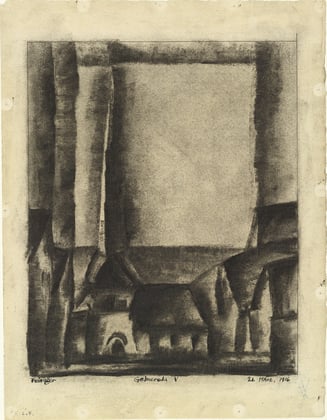
Lyonel Feininger’s Gelmeroda V (1926) stands as a masterwork of Expressionist cityscape painting, one that synthesizes the artist’s lifelong fascination with the Gothic architecture of Thuringian villages and his adoption of Cubist-derived spatial fragmentation. The work depicts the church of Gelmeroda, a subject Feininger returned to repeatedly—this fifth iteration being among the most resolved and luminous.
Significance within Expressionism and the Cityscape Genre
- Synthesis of Cubism and Expressionist Emotion: Feininger merges the analytic, multi-faceted planes of Cubism with the subjective, heightened emotion of Expressionism. The church is not a realistic rendering but a crystalline structure of overlapping, translucent geometric facets. This creates a sense of spiritual transcendence and dynamic energy, as if the building is vibrating with inner light.
- Light as a Structural Element: Unlike earlier Expressionists who used color for emotional shock (e.g., Kirchner’s acidic hues), Feininger employs a restrained, cool palette of blues, grays, and pale yellows. Light itself becomes a structural force: it fractures through the angled planes, suggesting dawn or the numinous glow of a divine presence. This reflects his interest in the “glass architecture” and spiritual clarity advocated by Paul Scheerbart.
- Architecture as Modernist Icon: The church spire, central and elongated, does not point to a conventional heaven but rather shatters into abstract shards. This represents Feininger’s belief in a new, modern spirituality—one that finds the sacred in the formal purity of geometric order. The cityscape is thus deconstructed and rebuilt as a personal vision of harmony, foreshadowing the Bauhaus ideal of uniting art, craft, and technology.
- Serial Exploration: By painting Gelmeroda multiple times, Feininger demonstrates a methodical evolution from naturalistic depiction to near-abstract icon. Gelmeroda V marks a peak where representational cues remain just legible (the spire, the silhouette of houses) while the composition is almost entirely non-objective. This places the work at the threshold between Expressionism and the pure abstraction that would dominate later 20th-century art.
Conclusion: Gelmeroda V is significant because it epitomizes Feininger’s unique contribution to Expressionism: a cool, intellectual mysticism that uses the cityscape as a vehicle for transcendent, orderly emotion. It bridges the emotional intensity of early Expressionism with the geometric discipline of the Bauhaus, making it a seminal work in the evolution of modern art.
Genere
Stile
Visivamente simili
20 opere con composizione e palette affini
Gelmeroda IX
Lyonel Feininger
The Cathedral
Lyonel Feininger
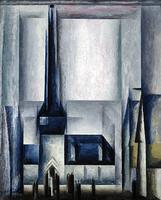
Gelmeroda III
Lyonel Feininger
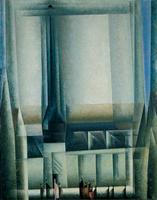
Gelmeroda VIII
Lyonel Feininger
The Village of Legefeld I (Dorf Legefeld I)
Lyonel Feininger
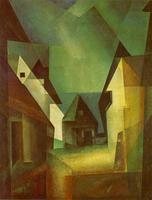
Gaberndorf II
Lyonel Feininger
Torturm II
Lyonel Feininger
Church of the Minorities in Erfurt I
Lyonel Feininger
Visions of a New World
Godfrey Blow
The time
Luc Tuymans
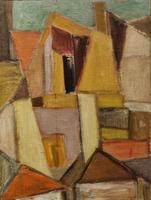
Modok Mária, Szentendrei Tetők 1940
Modok Mária
Modok Mária. Szentendrei Háztetők 1940
Modok Mária
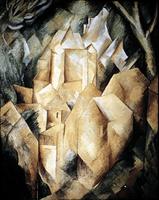
A House at Estaque
Georges Braque
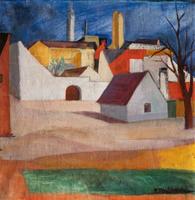
Modok Mária, Szentendrei Házak 1930
Modok Mária
Lelátás a templomdombról
Vajda Lajos
Houses on the hill
Pablo Picasso
Oberweimar
Lyonel Feininger
The Church of Carrières-Saint-Denis
Georges Braque
Landscape with Mill
Albert Gleizes
Gelmeroda XIII
Lyonel Feininger