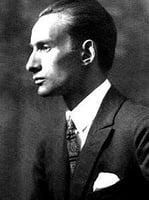
Analisi esperta di Kreuzabnahme di Christian Schad
Stile: Cubism · Genere: religious painting
Expert Analysis of Kreuzabnahme by Christian Schad
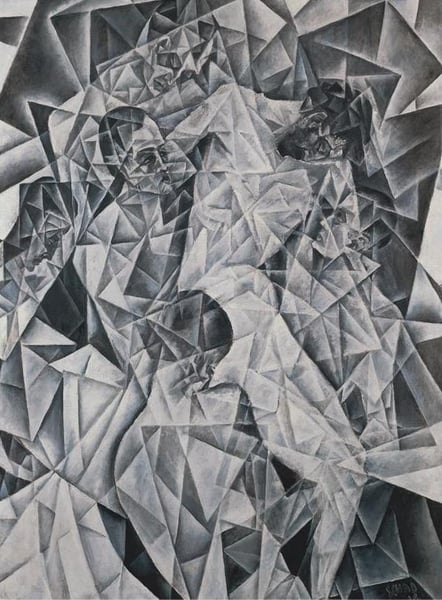
Although Christian Schad is most often associated with the sharp realism of New Objectivity, this work—designated here as a Cubist religious painting—represents a striking and early intersection of avant‑garde formal experimentation with a centuries‑old sacred subject. Kreuzabnahme (German for Deposition from the Cross) takes one of Christianity’s most emotionally charged moments—the lowering of Christ’s body after the Crucifixion—and reimagines it through the lens of Cubist visual language.
Significance within the Cubist movement:
-
Fragmentation of the sacred narrative. The painting breaks the human figures and the cross into angular, faceted planes, typical of Analytic Cubism. Christ’s body is no longer a naturalistic, suffering form but a series of interlocking geometries—shoulders, torso, and limbs appear simultaneously from multiple viewpoints. This fragmentation challenges the viewer’s expectation of devotional empathy, forcing a purely visual and intellectual engagement with the scene.
-
Traditional genre meets radical style. At the time (circa 1910s), Cubism was largely confined to still‑lifes, portraits, and abstracted landscapes. Applying its principles to a Kreuzabnahme—a subject laden with religious pathos—was highly unusual. Schad’s choice elevates Cubism from a formal exercise into a commentary on modern spirituality: the body of Christ is decomposed not as an act of desecration but as a way of stripping away sentimental illusion to reveal a raw, structural truth.
-
Innovative use of color and light. While many Cubist works favored muted earth tones, Kreuzabnahme reportedly employs a colder, more dissonant palette—greys, ochres, and slivers of white—that mimics the harsh, analytical light of a dissecting table. The cross itself becomes a geometric scaffold, while the mourners (Mary, John, Mary Magdalene) are reduced to angular silhouettes, their grief expressed through the tension of shattered shapes rather than facial expression.
Genre‑specific importance:
As a religious painting, Kreuzabnahme belongs to a lineage that stretches from medieval altarpieces to Baroque drama (e.g., Rembrandt, Rubens). Schad’s Cubist treatment subverts that tradition by replacing emotional continuity with cognitive dissonance. The work asks: Can a fragmented form still convey the sacred? In its bold synthesis of radical style and ancient subject, Kreuzabnahme stands as a pivotal—and often overlooked—example of how early modernism redefined the boundaries of spiritual art, anticipating later experiments by artists such as Georges Rouault and even the fractured religious imagery of post‑war Expressionism.
Visivamente simili
20 opere con composizione e palette affini
Woman sitting in an armchair
Pablo Picasso
The Descent from the Cross
Max Beckmann
Inferno I
Sidney Nolan
Nude figure
Pablo Picasso
A Couple
Pavel Filonov
Images of the war
Alberto Sughi
Untitled
Jackson Pollock
Seven Figures in a Landscape
Paul Ackerman
Composition I
Patrick Henry Bruce
Two Seated Figures
Robert Goodnough
Lovers Man and Woman
Egon Schiele
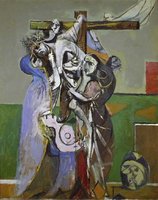
The Deposition
Graham Sutherland
Phèdre et Hyppolite
Jacques Villon
Three women
Pablo Picasso
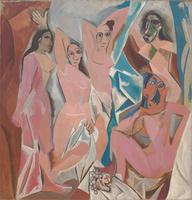
The girls of Avignon
Pablo Picasso
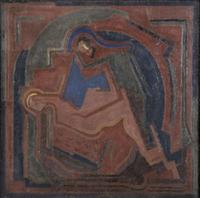
Pietà
Mainie Jellette
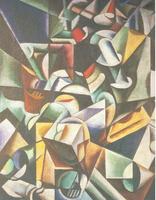
Female Model
Lyubov Popova
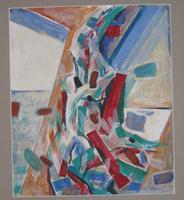
Composition
Hryhorii Havrylenko
L'Oiseau bleu (The Blue Bird)
Jean Metzinger
The Survivors. The War Series
Joan Tuset