
Chestnuts
Analisi esperta di Chestnuts di Stanley Spencer
Stile: Neo-Romanticism · Genere: genre painting
Expert Analysis: "Chestnuts" by Stanley Spencer
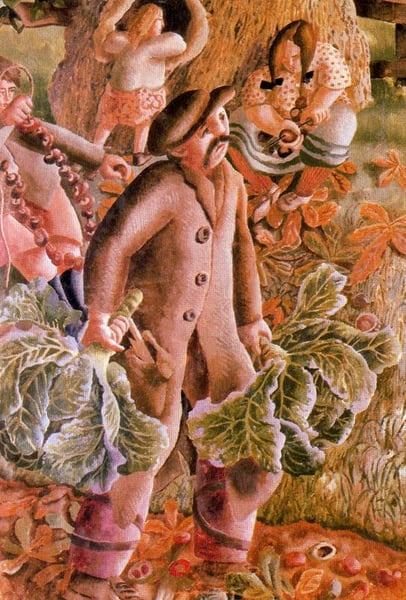
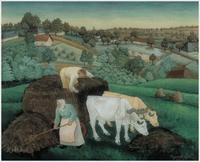
Stanley Spencer’s “Chestnuts” (likely from the 1930s or 1940s) exemplifies the Neo-Romantic impulse to find the extraordinary within the everyday, a hallmark of his deeply personal and visionary style. Painted in the genre of domestic or rural life, the work transforms a simple moment—perhaps a chestnut-gathering or roasting scene—into a quasi-sacred ritual.
Significance within Neo-Romanticism and Spencer’s Oeuvre:
-
Sacralization of the Mundane: Neo-Romanticism in Britain sought to reconnect with a mystical, often pastoral national identity following the upheavals of war. Spencer, a war artist and religious visionary, consistently infused ordinary village life (especially in his beloved Cookham) with intense spiritual and psychological weight. In “Chestnuts,” the act of preparing or sharing this humble food becomes a symbol of warmth, community, and survival—a quiet counterpoint to the industrial modernity and conflict threatening the rural idyll.
-
Idiosyncratic Composition and Perspective: Spencer’s characteristic use of abrupt, tilted perspectives and compressed space—often with figures locked in intimate, frozen gestures—is likely present here. He eschews naturalistic proportion, instead arranging human forms and objects (a basket, a fire, the chestnuts themselves) with a meticulous, almost obsessive clarity. This creates a dreamlike, hyperreal effect: the viewer is drawn into a scene that feels both familiar and alien, as if glimpsing a private ceremony.
-
The Painter of the Daily Miracle: Unlike the more lyrical or decorative Neo-Romantics (e.g., John Piper or Graham Sutherland), Spencer rooted his mysticism in the prosaic. “Chestnuts” likely emphasizes the physicality of the chestnuts—their textured shells, the crackle of flames, the hands of the figures—rendered with a naïve precision reminiscent of early Renaissance altarpieces. This tension between humble subject and elevated treatment makes the painting significant: it asserts that the sacred dwells not in cathedrals but in the kitchen, the hearth, the simple act of sharing food.
-
Personal and Wartime Resonance: If painted during or after WWII, chestnuts—a staple for roasting in British winters—carry connotations of making do and communal resilience. Spencer’s own post-war work often dwells on the persistence of domestic tenderness amid deprivation. “Chestnuts” thus becomes a quiet meditation on endurance, memory, and the redemptive power of small joys.
In summary, “Chestnuts” is significant as a masterful example of Spencer’s Neo-Romantic genre painting, where the ordinary is elevated to the sacramental. It encapsulates his belief that God is in the details—a conviction that makes his work a unique bridge between British pastoral tradition and modernist psychological intensity.
Visivamente simili
20 opere con composizione e palette affini
Summer
Pieter Bruegel the Elder
Party in vineyard
Ivan Generalic
Threshing
Boris Kustodiev

Daria takes away hay
Boris Kustodiev
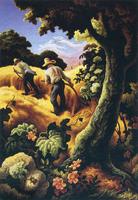
July Hay
Thomas Hart Benton
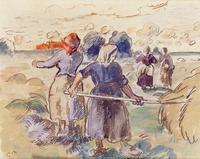
The Tedders
Camille Pissarro
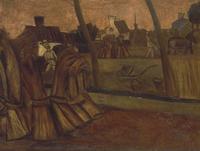
Harvest
Constant Permeke

13. Gathering the Harvest
Francis Davis Millet
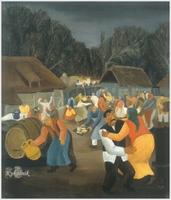
Country Dance
Ivan Generalic
Dancing at the Fair
Ivan Generalic
Harvester
Boris Kustodiev
Hay gathering
Ivan Generalic

The Harvest
Vela Zanetti
Haymaking
Paul Gauguin
Harvesting
Zinaida Serebriakova

Fire in a Haystack
Jules Breton
Golden Harvest
Radi Nedelchev
Haymaking in Eragny
Camille Pissarro
With a hammer (Trading)
Ivan Generalic
Transportation of hay
Ivan Generalic